
When managing Non-Emergency Medical Transportation (NEMT), deciding between manual dispatching and software-based solutions is critical for efficiency, compliance, and growth. Manual dispatch works for small fleets but struggles as operations scale. Software streamlines scheduling, improves on-time performance, ensures compliance, and reduces errors. Here’s a quick breakdown:
- Manual Dispatch: Relies on spreadsheets, whiteboards, and calls. Suitable for fleets under 5 vehicles. Cost-effective but time-consuming and prone to mistakes.
- NEMT Software: Automates scheduling, tracks vehicles with GPS, and integrates billing. Ideal for larger fleets, reducing scheduling time from hours to minutes and boosting on-time rates to 92–96%.
Quick Comparison:
| Factor | Manual Dispatch | NEMT Software |
|---|---|---|
| Scheduling Time | Up to 6 hours/day | ~45 minutes/day |
| On-Time Performance | ~78% | 92–96% |
| Compliance | Risk of HIPAA violations | Meets Medicaid standards |
| Claim Denial Rate | High | Up to 90% fewer denials |
| Cost | No subscription fees | $49–$350/vehicle/month |
| Scalability | Limited above 5 vehicles | Handles large fleets easily |
For small operations, manual methods can suffice. But as fleets grow or compliance requirements tighten, software becomes essential to save time, reduce costs, and improve service quality.
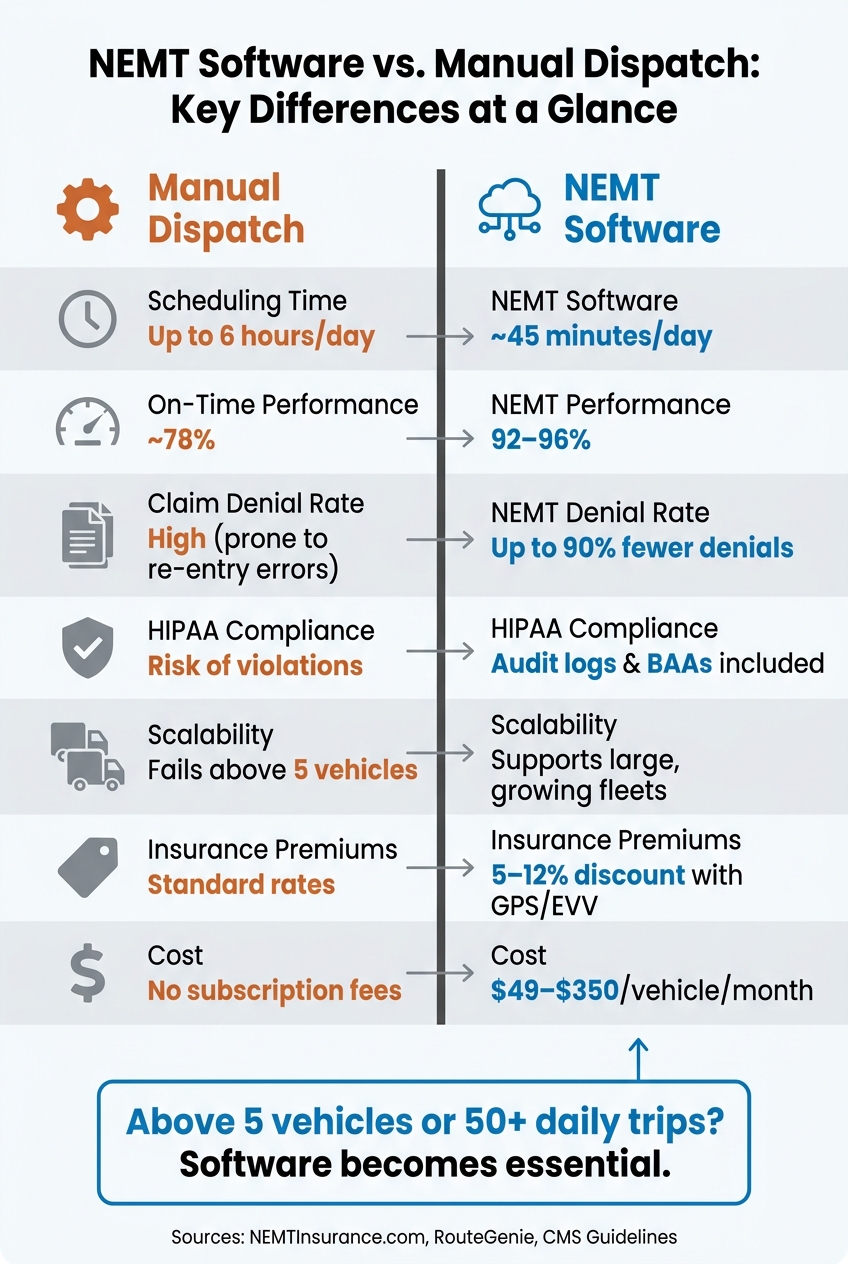
NEMT Software vs. Manual Dispatch: Key Stats & Differences
Manual NEMT Dispatch: How It Works and Where It Falls Short
What Manual Dispatch Looks Like in Practice
Imagine a small NEMT operation where dispatch relies on a mix of spreadsheets, a whiteboard, and constant phone calls. Trip details are jotted down in paper logs, while updates from drivers come through group texts or WhatsApp. If a trip repeats regularly, the dispatcher has to manually re-enter the same information every single time.
When unexpected changes happen – like a hospital discharge or a sudden cancellation – the dispatcher scrambles to call multiple drivers, trying to figure out who’s available and nearby. Once trips are completed, mileage, pickup times, and signatures are collected from paper logs or texts and then manually entered into a billing system. This process is not only time-consuming but also prone to mistakes, which can lead to claim denials.
These manual methods lay the foundation for understanding both their strengths and their shortcomings.
Where Manual Dispatch Works Well
Manual dispatch has its place, especially for small operations. If you’re running a fleet of just one to three vehicles and handling a few trips a day, a well-maintained spreadsheet paired with a tool like WhatsApp can work just fine. It’s cost-effective – no software subscriptions to worry about – and doesn’t require a steep learning curve. A small team can adapt quickly to changes without needing to learn a new platform.
There’s also a human touch to manual dispatch. A dispatcher who knows riders personally – their names, preferences, and specific needs – can sometimes respond more quickly and flexibly than a software system that requires data input before taking action.
The Risks and Limits of Manual Dispatch
However, as operations grow, the cracks in manual dispatch start to show. Without a system to track specialized vehicle capabilities – like whether a van has a particular lift type, oxygen storage, or stretcher capacity – mistakes happen. For instance, sending the wrong vehicle to a patient who needs specialized transport can cause serious delays. Additionally, manual processes often miss chances for ride-sharing, which drives up fuel costs and increases driver hours.
Another major concern is data security. Storing sensitive rider information on personal devices or unencrypted logs opens the door to HIPAA violations. During Medicaid audits, paper logs can’t provide GPS-verified timestamps or electronic signatures, both of which are crucial for EVV compliance.
The Garzor Insurance Operations Team summed it up well:
“Above 5 vehicles, manual dispatch (whiteboards, spreadsheets, phone calls) collapses. Trips get missed, broker scorecards drop, and your Medicaid broker contract gets put on probation.”
Statistics reinforce this point. Manual NEMT operations typically achieve an on-time performance rate of about 78%. Operators using manual systems also end up paying 5–12% more in insurance premiums compared to those who use electronic dispatch systems with GPS verification.
These challenges highlight why many NEMT providers eventually turn to software solutions to streamline operations and improve efficiency.
sbb-itb-af83355
NEMT Dispatch Software: Core Features and Benefits
Core Features Found in NEMT Dispatch Software
NEMT dispatch platforms are designed to streamline operations by reducing manual errors in scheduling, routing, billing, and compliance. This allows dispatchers to focus on handling exceptions rather than repetitive data entry.
Automated scheduling is a standout feature, leveraging route optimization algorithms to assign trips based on factors like appointment times, vehicle capacity, rider needs, and opportunities for shared rides. For example, platforms like Bambi use AI to identify shared ride opportunities automatically, while Tobi’s structured workflows are ideal for high-volume fleets that work closely with brokers. These tools cater to diverse operational needs across the NEMT landscape.
Real-time GPS tracking and EVV (Electronic Visit Verification) ensure accurate, GPS-stamped pickup and drop-off times, along with electronic signatures. These features help operators meet Medicaid compliance requirements, which are expected to become mandatory in most states by 2026–2027, according to CMS guidance.
On the billing side, automated billing workflows streamline the claims process by routing trip data directly into claim formats like 837P and CMS-1500. This eliminates the need for manual data entry, a common cause of claim denials. Operators using these integrated systems have reported up to 90% fewer claim denials compared to manual methods. Platforms with native EDI integrations, such as those with ModivCare and MTM, are particularly beneficial for fleets managing over 30 trips per day.
These core features form the backbone of various NEMT software platforms, which are tailored to meet the needs of operators of different sizes and complexities.
NEMT Software Platforms: A Brief Overview
The U.S. NEMT market offers a variety of software options, each catering to specific fleet sizes and operational demands. Here’s a snapshot of some popular platforms:
| Platform | Best Fit | Notable Strengths |
|---|---|---|
| TripMaster | Small to mid-size fleets moving off spreadsheets | Structured scheduling; a common entry-level choice |
| Tobi | 10–200 vehicle fleets with heavy broker volume | Strong EDI integrations with major brokers |
| Bambi | Startups and small fleets (1–8 vehicles) | Mobile-first design; AI-assisted scheduling |
| RouteMatch | Mid to large paratransit and NEMT operations | Well-established platform with broad transit support |
| NEMT Cloud Dispatching | Budget-conscious operators across fleet sizes | Transparent pricing starting at $99/month; supports NEMT, paratransit, and school transport |
Pricing for these platforms typically ranges from $49 to $350 per vehicle per month. Larger deployments may also incur implementation fees, which can range between $2,000 and $8,000.
How Software Improves Day-to-Day Dispatch Operations
Switching to NEMT dispatch software delivers clear, measurable improvements in day-to-day operations. For instance, an 18-vehicle operator in Atlanta adopted Tobi and saw on-time performance jump from 81% to 94%. This upgrade not only improved their Medicaid broker scorecard but also generated nearly $94,000 in annual margin gains.
Scheduling efficiency is another area where software shines. Great Lakes PACE, for example, used RouteGenie’s Auto Preassign tool to cut daily scheduling time from six hours to just 45 minutes. This freed up dispatchers to focus on managing real-time disruptions, reducing labor costs, and improving overall efficiency.
“Dispatch software replaces 1–2 full-time dispatchers per 25 vehicles and lifts on-time performance from ~78% to 92–96%.” – NEMT Insurance
In addition to operational benefits, using platforms with GPS verification can lead to insurance premium discounts. Operators typically see savings of 5% to 12%, and those with full dispatch, GPS, and telematics setups can achieve reductions of 8% to 15%. For mid-size fleets, these savings can significantly offset the monthly cost of software subscriptions.
Manual Dispatch vs. NEMT Software: A Direct Comparison
Efficiency and Accuracy
Manual dispatch systems, like whiteboards and spreadsheets, struggle to adapt to real-time changes. They can’t automatically handle delays, last-minute trip adjustments, or overlapping routes. This means dispatchers must constantly monitor schedules to avoid missed appointments or conflicts.
On the other hand, NEMT software treats scheduling as a dynamic process. Automated algorithms instantly match riders to the right vehicles, factoring in appointment times, vehicle requirements, and shared-ride opportunities. Industry data shows that while manual dispatch becomes ineffective with more than five vehicles, software can efficiently manage even large fleets without the need for additional staff.
“The same van you booked for a 9:00 a.m. dialysis run can be idle during a conflicting 9:05 wheelchair return ten miles away [in a manual system]. Nothing flags the conflict.” – RouteGenie
Beyond scheduling, software improves compliance and documentation, reducing the risks tied to manual systems.
Compliance and Documentation
Manual record-keeping exposes operators to legal risks, especially when handling sensitive rider information. For example, storing medical appointment details in personal calendars isn’t just risky – it’s a direct violation of HIPAA regulations. Additionally, paper logs and handwritten timestamps often fail to meet Medicaid audit standards. A single missed prior authorization can lead to denied reimbursements and wasted time on appeals.
NEMT software eliminates these risks with features like GPS-stamped EVV (Electronic Visit Verification) data, electronic signatures, and automated audit logs. These tools create an airtight record for every trip. Plus, credential tracking ensures that critical details – like driver license renewals or vehicle inspections – aren’t overlooked. For operators working with brokers like New York’s MAS, which requires GPS breadcrumb data, manual systems simply don’t meet the requirements.
Cost and Scalability
When comparing costs, it’s not just about subscription fees versus labor hours. Manual processes often involve re-entering data across multiple systems – like broker portals, spreadsheets, and billing tools. Each transfer increases the risk of errors, which can lead to claim denials. These inefficiencies not only slow operations but also create barriers to scaling up, while software streamlines data flow and supports fleet growth.
Here’s a side-by-side comparison of manual dispatch and NEMT software:
| Factor | Manual Dispatch | NEMT Software |
|---|---|---|
| Scheduling speed | Hours spent building daily manifests | Minutes with automated tools |
| On-time performance | ~78% average | 92–96% with software |
| Claim denial rate | High; prone to re-entry errors | Up to 90% fewer denials |
| HIPAA compliance | Often non-compliant | Audit logs and BAAs included |
| Scalability | Fails above 5 vehicles | Supports large, growing fleets |
| Insurance premiums | Standard rates | 5–12% discount with GPS/EVV |
“The cheapest platform that misses 8% of broker billing costs more than the most expensive one that catches it.” – NEMTInsurance.com
For growing fleets, the benefits of software are clear. Take the example of an Atlanta operator with 18 vehicles. After switching to the Tobi platform, their on-time performance jumped from 81% to 94% in just 90 days. This improvement upgraded their Medicaid broker scorecard from Tier 2 to Tier 1 and added approximately $94,000 in annual profit, all for a $48,000 software investment. The software didn’t just save time – it enabled them to take on more trips and grow their business efficiently.
Choosing Between Manual Dispatch and Software
Operators must decide whether to stick with manual dispatch methods or transition to software, considering the efficiency, compliance, and cost factors discussed earlier.
When Manual Dispatch Is Still a Workable Option
For smaller, straightforward operations, manual processes can still get the job done – if managed with discipline. If you’re running fewer than 5 vehicles and handling fewer than 40 trips daily, tools like spreadsheets, Google Maps, and group chats can suffice. This approach works best for single-broker or private-pay operations with simple, predictable routes.
“Below 5 vehicles, dispatch software matters less than dispatch discipline.” – NEMTInsurance.com Editorial
That said, as operations grow in complexity, manual methods quickly lose their effectiveness.
When Software Becomes the Better Choice
The need for dispatch software often arises as operations expand. If you’re managing more than 5 vehicles, dealing with Medicaid broker contracts requiring EDI or API integration, or experiencing a rising trip denial rate, manual processes may be holding you back. Challenges like recurring trips (e.g., 156 annual dialysis appointments), EVV compliance, shared rides, and GPS-stamped audit logs add layers of complexity that dispatch software can streamline. These features become essential, regardless of fleet size.
| Fleet Size | Recommended Approach |
|---|---|
| 1–5 vehicles | Manual or entry-level SaaS (e.g., Bambi, Elite Route Dispatch) |
| 6–20 vehicles | Mid-market platforms (e.g., NEMT Cloud Dispatching, NEMT Pulse) |
| 20+ vehicles | Enterprise platforms (e.g., Tobi, RouteGenie) |
When these pressures build, transitioning to a software-based system becomes a logical next step.
How to Move from Manual to Software-Based Dispatch
Switching to dispatch software helps address inefficiencies and risks inherent in manual workflows. Start by auditing your current processes and ensuring the software you choose supports all necessary broker EDI/API connections. Map out your trip lifecycle – from booking to claim payment – and identify where manual data re-entry occurs. Focus on software with robust broker integration rather than prioritizing cost or user interface design.
Timing your migration is key. Aim for Q2 (April–June) or late Q4 (November–December) to avoid overlaps with insurance renewals or audit cycles, which require stable historical data. During the transition, run the new software in parallel with your current system for 30–60 days to ensure billing reconciliation works seamlessly before fully switching over. Even after going live, retain legacy records in read-only mode for at least 12 months to assist with audits or billing disputes.
Budgeting is another critical consideration. For example, a 10-vehicle fleet on a $40/vehicle/month plan will spend about $4,800 annually on software fees. However, first-year costs typically range from $14,000 to $18,000 when factoring in implementation, training, and broker integration fees. While the upfront investment may seem steep, the cost of sticking with manual processes in an outgrown operation can be even higher.
Conclusion: Key Takeaways for NEMT Operators
Choosing the right dispatch method depends heavily on your operation’s size and growth plans. For smaller fleets, manual dispatching can suffice. However, if your fleet surpasses 5 vehicles or you’re managing over 50 trips daily, the benefits of automated dispatch software become undeniable. At this scale, efficiency and compliance become harder to achieve without technology.
Compliance is a major factor. By 2026–2027, CMS guidelines will require GPS-stamped EVV, making paper logs obsolete. Delaying this transition could lead to audits and penalties, putting your operation at risk.
Beyond compliance, dispatch software offers substantial efficiency improvements. It boosts on-time performance from about 78% to 92–96% and slashes the time spent creating daily manifests – from six hours to just 45 minutes. These improvements translate into better driver productivity, more accurate billing, and streamlined operations.
“Dispatch software is the single highest-leverage tech investment for NEMT operators above 5 vehicles.” – NEMTInsurance.com
While cost concerns are valid, the return on investment often outweighs initial expenses. As NEMTInsurance.com puts it, “the cheapest platform that misses 8% of broker billing costs more than the most expensive one that catches it.” With financial savings, operational efficiency, and compliance benefits, advanced dispatch solutions are a smart choice for growing fleets. When evaluating software, prioritize features like EDI depth and EVV capabilities to protect your revenue and maintain compliance.
FAQs
How do I know when manual dispatch has stopped working for my fleet?
When your fleet expands beyond a handful of vehicles or occasional trips, manual dispatch methods often start to fall apart. You might notice issues like increased deadhead miles, missed pickups, driver miscommunication, or billing mistakes caused by fragmented trip data. If your team is constantly juggling spreadsheets just to track key metrics like trip volume or claim rates, it’s probably time to look into cloud-based NEMT software. This type of software can simplify scheduling, routing, and billing, helping you manage operations more efficiently.
What software features are essential for Medicaid compliance and audits?
To stay on top of Medicaid compliance and be prepared for audits, software needs to have detailed audit trails with verified timestamps and mileage logs. Essential tools include advanced billing features for 837P claims, HCPCS modifiers, and automated 835 posting. Maintaining HIPAA-compliant access controls is crucial for managing sensitive information securely. Additionally, integrated broker EDI and GPS tracking ensure data accuracy, while immutable audit logs play a key role in settling billing disputes efficiently.
How long does it take to switch from spreadsheets to dispatch software?
Switching from spreadsheets to NEMT dispatch software usually takes about 60 to 90 days from signing the contract to full implementation. To minimize risks, it’s best to avoid making the transition during busy times like audits or contract renewals. While it might be tempting to aim for a faster timeline – under 45 days – this often leads to skipped billing tests, which can create problems down the road. A smooth transition involves several key steps: migrating your data, training your team, and operating both systems side by side for 30 to 60 days to ensure everything runs seamlessly.