
Managing a Non-Emergency Medical Transportation (NEMT) fleet is challenging in 2026. Rising costs for fuel, labor, and insurance – paired with fixed Medicaid reimbursements – make profitability a constant struggle. But with smarter strategies, you can save $12,000 to $22,000 annually for a 10-vehicle fleet. Here’s how:
- Route Optimization: Reduces empty miles by 8-15%, saving up to $1,400 monthly on fuel.
- Cloud Dispatch & Telematics features: Automates scheduling, tracks inefficiencies, and cuts idling costs by $2,000/month.
- Preventive Maintenance: Avoids breakdowns, lowers repair costs, and ensures vehicle reliability.
- Fuel Efficiency: Training drivers and monitoring behavior can cut fuel costs by 8-12%.
- Accurate Billing: GPS-verified timestamps and automated systems reduce claim denials. Choosing NEMT software vs. manual dispatch is often the first step toward this automation.
- Driver Training: Focused sessions improve route compliance and reduce errors.
- Insurance Management: Bundling policies and using telematics can lower premiums.
- Data Analytics: Tracking costs per trip and key metrics helps identify savings opportunities.
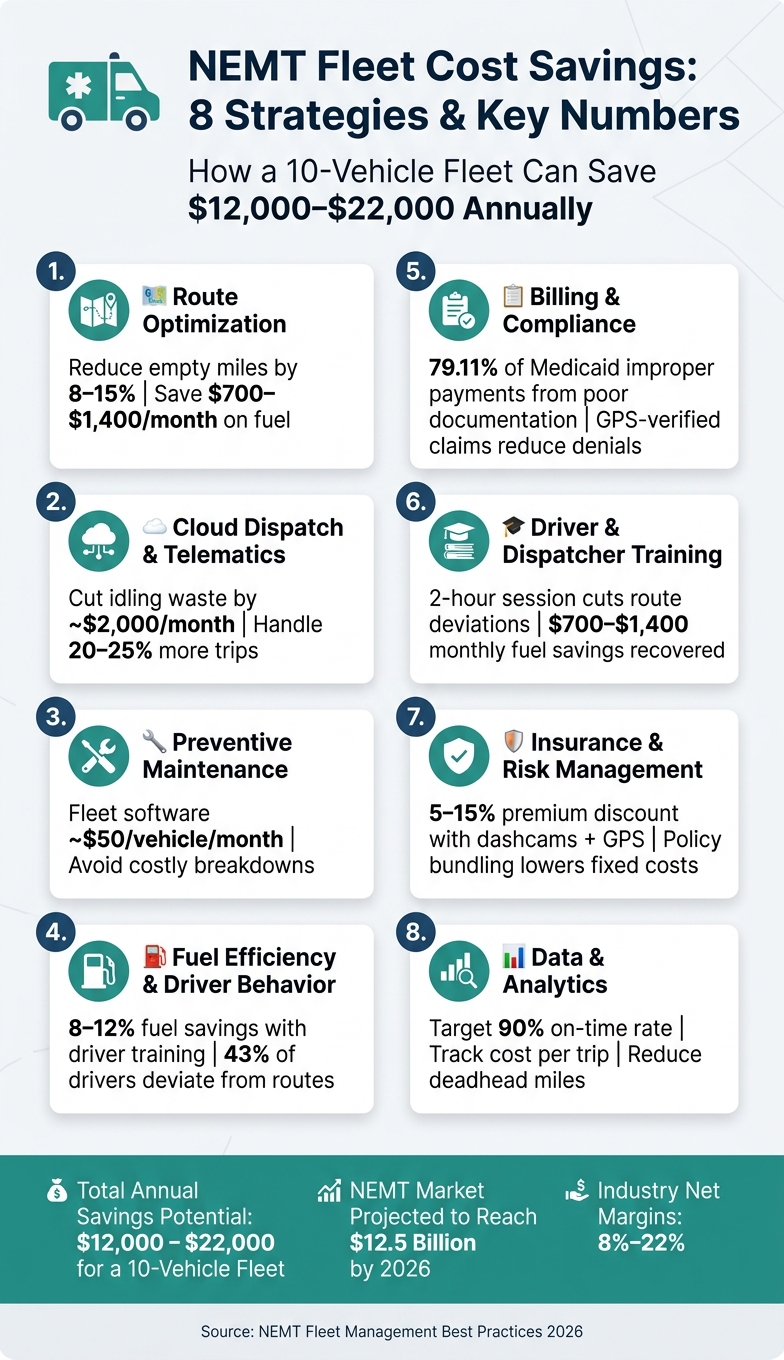
NEMT Fleet Cost Savings: 8 Strategies & Key Numbers
Crushing Deadhead Miles in NEMT: Smart Strategies to Charge for or Avoid Them
sbb-itb-af83355
1. Optimize Routes and Cut Empty Miles
One of the biggest hidden costs in NEMT fleet management is deadhead mileage – the distance vehicles travel without passengers. These “empty miles” can account for 15% to 25% of a fleet’s daily mileage, and with fuel costs ranging from $0.22 to $0.35 per mile, the expenses add up quickly.
The solution? Smarter dispatching through route optimization. Modern tools can group trips geographically, assign vehicles based on real-time locations, and adjust routes on the fly for cancellations or no-shows. This dynamic approach can improve efficiency by 5% to 10%, compared to static overnight planning. The result? Noticeable improvements in operational performance.
For example, a 10-vehicle fleet using route optimization can reduce total mileage by 8% to 15%, saving between $700 and $1,400 monthly – or $8,400 to $16,800 annually. But the benefits don’t stop at fuel savings. Streamlined routing increases trip density, enabling drivers to handle more trips per day. Moving from 6 trips to 10 trips daily can slash per-trip labor costs by as much as 40%.
However, even the best software won’t deliver results if drivers don’t stick to the plan. Research shows that 43% of drivers using optimization tools regularly stray from assigned routes. To combat this, tools like GPS tracking, turn-by-turn navigation apps, and post-trip compliance reporting are crucial. Kumail Haider, an expert in NEMT platforms, emphasizes:
“Every unauthorized detour erases part of your savings. You need a system with GPS tracking and post-trip route compliance reporting to measure and address this.”
The good news? Route optimization platforms tailored for NEMT fleets typically cost $300–$800 per month and often pay for themselves within 1 to 3 months. The return on investment is clear. As RouteGenie explains:
“With route optimization, you can increase the number of trips you can fit into your overall schedule, even with fewer vehicles.”
For most fleets, this means handling 20% to 25% more trips without needing to add more vehicles. The combination of reduced mileage, lower costs, and higher trip capacity makes route optimization a game-changer for NEMT providers.
2. Use Cloud Dispatch and Telematics to Run a Leaner Fleet
Manual dispatching can seriously disrupt NEMT (Non-Emergency Medical Transportation) operations. It often leads to overlapping routes, missed documentation, and scheduling mistakes. Cloud-based dispatch tools tackle these problems by automating error-prone workflows. This automation sets the stage for telematics to further reduce inefficiencies.
One big advantage of automated systems is better compliance. According to CMS, 79.11% of Medicaid improper payments in FY 2024 were due to insufficient documentation. With cloud dispatch tools, GPS timestamps, driver logs, and patient updates are automatically recorded at every stage of a trip. This creates a digital audit trail that minimizes claim errors and stands up to payer audits.
Telematics takes this a step further by identifying inefficiencies in fleet operations. For instance, a passenger van idling unnecessarily burns about 0.8 gallons of fuel per hour. Across a 10-vehicle fleet, this could waste nearly $2,000 a month. Additionally, matching the right vehicle to the right trip – like avoiding the use of costly wheelchair vans for ambulatory passengers – can reduce operating costs by 5% to 8%.
“Automation captures timestamps, trip updates, driver logs, and patient statuses automatically. It creates a unified, accurate audit trail.” – Ishika Banerjee, Content Writer, Tobi Cloud
Real-time route re-optimization also makes a big difference, improving adherence to planned routes by 30% compared to static schedules. Platforms like NEMT Cloud Dispatching combine scheduling, GPS tracking, billing automation, and mobile driver apps into one system. Basic plans start at around $99 per month, while mid-market options for a 10-vehicle fleet range from $300 to $800 per month. Software like RouteGenie uses these capabilities to streamline NEMT operations even further.
3. Build a Preventive Maintenance and Vehicle Lifecycle Plan
Keeping vehicles in top shape is just as important as optimizing routes when it comes to cutting costs in NEMT operations.
Relying on reactive repairs can be a financial drain. A breakdown mid-route doesn’t just mean repair bills – it also means missed trips, rescheduling patients, and scrambling to find a backup vehicle. A well-thought-out preventive maintenance plan can turn these surprises into predictable, manageable expenses. Here’s how to make it work.
“Vehicle reliability directly affects service quality. Preventive maintenance should be a core component of NEMT fleet operations management.” – Bob Martin, NEMT Cloud Dispatching
Using tools like digital trip checklists and automated maintenance alerts can make a big difference. For instance, drivers can use a mobile app to complete inspections at the start and end of their shifts, flagging potential issues before they escalate. Pair this with fleet management software – typically around $50 per vehicle per month – and you’ll spend far less than you would on major breakdowns or compliance violations.
ADA-compliant equipment like hydraulic lifts and ramps also needs its own maintenance schedule. Regular inspections ensure everything meets federal safety standards, avoiding costly fines and unexpected downtime. Staying on top of these checks not only ensures passenger safety but also helps control costs.
Deciding when to retire a vehicle is another key part of the equation. Tracking the cost per mile – usually between $0.65 and $0.85 for transit vans and modified minivans – can signal when a vehicle is no longer worth keeping. Replacing vehicles at the right time is much cheaper than waiting for a breakdown to force your hand.
Another smart move? Match the right vehicle to the right trip. For example, using a wheelchair-equipped van for a trip that doesn’t need it adds unnecessary wear to expensive equipment. Proper vehicle-to-trip matching can reduce overall operating costs by 5% to 8%, while ensuring specialized vehicles are available when they’re truly needed. Combining preventive maintenance with thoughtful fleet allocation is a powerful way to keep costs in check.
4. Improve Fuel Efficiency and Driver Behavior
Fuel expenses are a major concern in NEMT (Non-Emergency Medical Transportation) operations, often accounting for a large portion of variable costs. For a fleet of 10 vehicles, monthly fuel costs typically range from $8,000 to $15,000. The good news? A significant portion of these expenses can be trimmed without hefty investments. By managing fuel use and encouraging better driving habits, operators can see substantial savings.
Two key culprits behind fuel waste are unnecessary idling and route deviations. Did you know that a van burns about 0.8 gallons of fuel for every hour it idles? If each vehicle idles for just 20 minutes per trip across eight trips daily, that adds up to roughly $1,950 in wasted fuel every month. On top of that, a 2021 survey revealed that 43% of drivers frequently stray from optimized routes, undermining the benefits of route planning software and increasing fuel consumption.
“Driver non-compliance with optimized routes was the single largest factor in closing the gap between projected and actual savings.” – Fleet Owner Magazine
To tackle these issues, modern tools like telematics and mobile apps can make a big difference. Features such as idle-time alerts, post-trip analyses comparing planned versus actual routes, and driver safety scorecards provide actionable insights. Equipping drivers with a dedicated navigation app, instead of relying on personal GPS devices, improves route compliance and reduces unnecessary detours. Plus, installing dashcams alongside GPS tracking might even qualify operators for insurance discounts of 5% to 15%, adding another layer of savings.
Driver training also plays a huge role. A short, focused training session – just two hours long – can teach fuel-efficient driving techniques like smooth acceleration, reducing idling, and sticking to dispatch instructions. These small adjustments can cut fuel costs by 8% to 12%. Pairing this training with performance bonuses tied to safety scorecards gives drivers a clear incentive to embrace these habits. Additionally, assigning the right vehicle for the job – like using a sedan for an ambulatory patient instead of a fuel-hungry wheelchair van – can further reduce fuel consumption and operating costs.
| Driver Factor | Potential Cost Impact |
|---|---|
| Fuel-efficient driving techniques | 8%–12% fuel savings |
| Unnecessary idling (per hour, van) | ~0.8 gallons burned |
| Route deviation (43% of drivers) | Reduces projected fuel savings |
| Safety tech (dashcams + GPS) | 5%–15% insurance premium discount |
| Vehicle-to-trip matching | 5%–8% reduction in operating costs |
Together, these strategies enhance existing route optimization and maintenance efforts, creating a well-rounded approach to reducing costs in NEMT operations.
5. Tighten Billing, Compliance, and Claim Accuracy
Billing mistakes and compliance gaps can quietly drain profits in NEMT operations. In fact, 79.11% of Medicaid improper payments in FY 2024 were due to insufficient documentation, according to CMS data. This isn’t just a software issue – it’s a matter of maintaining strong data practices. To ensure every dollar you’ve earned is accounted for, accurate billing and documentation are non-negotiable. A missing timestamp, an unverified pickup, or an undocumented no-show can all lead to denied claims.
“Insufficient or incorrect documentation directly affects providers’ ability to recover earned revenue.” – CMS
One of the main culprits? Disconnected tools. Manually transferring data between systems often introduces errors. By consolidating billing, GPS-verified timestamps, driver logs, and trip status updates into a single system, you reduce the risk of duplicate entries and ensure billing data reflects real-time field activity.
GPS validation plays a key role here. Tying billing to GPS-verified pickup and drop-off data provides the proof Medicaid auditors and brokers require. Additionally, cancellations and no-shows must be logged immediately to prevent documentation gaps – delayed entries can result in claim denials.
Here’s how specific technology features can improve compliance and billing outcomes:
| Feature | Compliance Impact | Billing Impact |
|---|---|---|
| GPS Validation | Provides audit-proof pickup/drop-off records | Prevents mileage discrepancies in claims |
| Automated Timestamps | Ensures Medicaid documentation standards are met | Reduces manual entry errors |
| Digital Signatures | Confirms patient transport completion | Lowers first-pass claim denial rates |
| Real-Time No-Show Logging | Keeps compliance records clean | Avoids billing for unperformed trips |
| Compliance Reporting | Produces audit-ready documentation | Speeds up reimbursement cycles |
Streamlined billing processes not only protect your revenue but also align with overall cost-saving efforts in fleet management. For instance, implementing digital checklists can strengthen your audit trail. When drivers document vehicle condition, mileage, and equipment status – like ADA lift functionality – before and after each shift, that data becomes part of your compliance records. These small, consistent habits can make a big difference when brokers or Medicaid agencies review your claims.
6. Train Drivers and Dispatchers to Lower Costs
While advanced tools can fine-tune routes and improve dispatching, their full potential depends on the skills of drivers and dispatchers. Technology alone isn’t enough – it needs capable people behind it. As Bob Martin of NEMT Cloud Dispatching explains:
“Even the best technology cannot replace well-trained drivers and dispatchers.”
Proper training helps teams maximize the benefits of cloud-based vs. on-premise NEMT software and telematics. For example, route deviations and documentation errors can lead to unnecessary costs. A focused training session – just two hours long – can address this. By explaining the financial impact of sticking to optimized routes and requiring drivers to use a company-provided app instead of personal GPS devices, businesses can recover lost fuel savings.
Dispatchers also play a key role. With training on automated scheduling systems, they can seamlessly handle same-day trip changes and maintain accurate documentation, reducing billing errors and preventing revenue loss.
Here’s a breakdown of how targeted training can lead to measurable cost savings:
| Training Focus | Operational Impact | Cost-Saving Benefit |
|---|---|---|
| Route Compliance | Reduces unauthorized detours | 8%–15% mileage reduction; $700–$1,400 monthly fuel savings |
| Defensive Driving | Lowers accident rates | Reduced insurance premiums and repair costs |
| Idle Time Monitoring | Cuts unnecessary engine idling | Up to $1,950 saved monthly for a 10-vehicle fleet |
| Billing & Documentation | Higher first-pass claim approval | Improved cash flow with less rework |
| Automated Scheduling | Handles more trips per shift | 20%–25% more trips without adding vehicles |
Training doesn’t have to disrupt operations. Short, targeted sessions – covering topics like route adherence, checklists, or software workflows – can be highly effective without taking up too much time. Managers can also use time-tracking tools to identify productivity gaps and provide additional coaching where needed. Combining these training efforts with advanced dispatch tools ensures that every team member is equipped to make the most of the technology, locking in long-term cost savings.
7. Manage Insurance, Risk, and Safety to Control Costs
Insurance is one of the largest fixed costs in NEMT operations, but it’s also something operators can manage. By consolidating all fleet insurance policies under a single provider, adding anti-theft devices, and ensuring drivers have defensive driving certifications, operators can lower their risk profile and, in turn, reduce premiums. Telematics systems that track behaviors like speeding and hard braking can provide documented proof of safe driving practices, giving operators more leverage when negotiating with insurers.
Proactive safety measures go beyond just reducing premiums – they help limit risk overall. For example, digital pre- and post-trip checklists encourage drivers to inspect critical vehicle components, such as brakes and mileage, at the start and end of each shift. Catching potential issues early can prevent costly accidents or breakdowns. Similarly, matching the right vehicle to the appropriate trip is crucial. Using a mismatched vehicle not only increases liability risks but also drives up operating costs unnecessarily.
Accurate documentation plays a key role in managing risks and controlling costs. Automated audit trails that log GPS-verified timestamps and driver activity create a reliable record, which can protect operators from denied claims and legal disputes.
| Risk Management Strategy | Cost Impact |
|---|---|
| Policy bundling | Reduces insurance premiums directly |
| Telematics monitoring | Supports premium reductions through proof of safe driving |
| Pre/post-trip checklists | Cuts costs tied to breakdowns and accidents |
| Automated audit trails | Lowers risk of denied claims (79.11% of Medicaid denials) |
| Vehicle-to-trip matching | Reduces liability and operating inefficiencies |
These strategies work together to create a strong risk management system that aligns with digital documentation practices.
Yurii Martynov, Marketing Director at RouteGenie, emphasizes the importance of technology in NEMT operations:
“You have to digitize your business operations in order to meet the increasing demand from clinics and other health providers for professional medical transportation services for patients.”
Centralizing driver credentials, background checks, and health permits within a single system simplifies audits and strengthens cost-control efforts. This approach ensures compliance with state and federal regulations while reducing the risk of expensive violations.
8. Use Data and Analytics to Find and Fix Cost Leaks
Once you’ve fine-tuned your routes and improved driver performance, the next step is to dig into your data. Numbers don’t lie, and they can help uncover hidden cost leaks that might otherwise go unnoticed. Many NEMT operators feel the pinch of rising expenses but lack the data to pinpoint exactly where the money is slipping away. A good starting point? Calculate your cost per trip using three months’ worth of fuel receipts, trip logs, and labor and maintenance expenses. This will give you a baseline to measure any improvements.
“Knowing your cost per trip isn’t optional – it’s the difference between growing a business and slowly going bankrupt.” – NEMTInsurance.com
Once you have a baseline, focus on a few critical metrics to track your progress. For example, aim for a 90% on-time pickup rate and reduce deadhead mileage by clustering trips more efficiently. Another key metric is route adherence – ensuring drivers stick to optimized routes. Surprisingly, research shows that 43% of drivers using route optimization software still deviate from planned routes. These detours may seem minor but can quietly chip away at your cost savings.
Daily or weekly reviews of these metrics can help you catch inefficiencies early. Take idle time, for instance. It’s an often-overlooked expense that adds up fast. Did you know a passenger van burns about 0.8 gallons of fuel per hour of idling? For a fleet of 10 vehicles, just 20 minutes of idling per trip can lead to nearly $2,000 in wasted fuel each month. Telematics systems can track idling automatically, but the data is only useful if someone reviews it regularly. A weekly dashboard review can help you spot and address these issues before they snowball.
Data can also help you understand which trips are making – or losing – you money. For instance, ambulatory trips typically cost between $38 and $42 to complete but only reimburse $30 to $45. On the other hand, wheelchair and stretcher trips often have better profit margins. Without tracking these details, you might unintentionally grow the least profitable part of your business.
| Metric | What It Reveals | Target |
|---|---|---|
| Cost per Trip | Overall operational efficiency | Varies by trip type |
| On-Time Rate | Service reliability and penalty risk | 90% or higher |
| Route Adherence | Unauthorized detours and wasted optimization | Minimize deviations |
| Deadhead Miles | Dispatching and clustering inefficiencies | Reduce through trip grouping |
| Idle Time | Wasted fuel during wait periods | Under 5–10 minutes per trip |
| No-Show Rate | Revenue lost to unproductive driver time | Reduce from 8%–12% average |
Using data isn’t just about tracking numbers – it’s about turning those numbers into actionable insights. The right metrics can help you plug leaks, improve efficiency, and ultimately boost your bottom line.
Conclusion
Running a profitable NEMT fleet in 2026 boils down to one key principle: cutting waste before it spirals out of control. The eight strategies discussed here – ranging from route optimization and cloud-based dispatch to preventive maintenance, billing accuracy, and data analytics – target specific areas where costs tend to leak. Each one is designed to ensure every dollar spent delivers maximum value, shifting operations from reactive to deliberate.
The numbers speak for themselves. For example, a 10-vehicle fleet implementing route optimization, idle reduction, and automated billing could save $12,000 to $22,000 annually on fuel and maintenance alone. Add to that the financial benefits of better claims accuracy and thorough documentation – especially given that 79.11% of Medicaid improper payments result from insufficient documentation – and the savings grow even more significant. With industry net margins usually hovering between 8% and 22%, addressing these inefficiencies can make all the difference.
Fleet size plays a big role in deciding where to start. Smaller fleets (5–10 vehicles) see the quickest returns from basic tools like automated scheduling and route optimization. Medium-sized fleets (10–50 vehicles) can benefit from features like trip clustering, driver apps, and real-time re-routing. For larger fleets (50+ vehicles), enterprise-level analytics and multi-depot planning become essential for managing complexity. The key is identifying where your biggest losses are happening and tackling those first.
A smart first step? Conduct a baseline audit. Use it to calculate your cost per trip and track deadhead miles. From there, you can refine routes to save on fuel, encourage safer driving to reduce insurance risks, and improve documentation to avoid billing disputes.
“Automation marks a decisive turning point, enabling high-capacity NEMT operations to regain cost control, visibility, and secure, sustainable margins.” – Ishika Banerjee, Tobi Cloud
With the NEMT market projected to hit $12.5 billion by 2026, the competition for broker contracts is only heating up. Operators who focus on refining their processes today will be better positioned to grow steadily and meet the industry’s increasing compliance standards.
FAQs
Which cost-saving change should I implement first in my NEMT fleet?
Adopting automated NEMT dispatch software can transform the way you manage operations. With cloud-based scheduling tools, you can replace time-consuming manual processes with automated systems for scheduling, dispatching, and trip updates. This not only cuts down on errors but also minimizes unnecessary mileage by clustering trips more efficiently.
By improving vehicle utilization, these tools offer greater visibility into operational data. This visibility allows you to monitor performance, refine routes, and uncover additional cost-saving opportunities. For example, you can identify areas where preventive maintenance or enhanced driver training might lead to better efficiency and reduced expenses.
What metrics should I track weekly to find cost leaks fast?
To stay on top of cost leaks, keep a close eye on important metrics every week. Pay attention to cost per trip (including fuel, driver time, and maintenance), fuel consumption per mile, driver idle time, no-show or canceled appointments, and the on-time pickup rate. Another key area to monitor is the difference between planned routes and actual miles driven – this helps cut down on unnecessary deadhead mileage. Leveraging cloud-based NEMT software can make this process easier by providing automated reports for seamless tracking.
How can I reduce Medicaid claim denials without adding office staff?
To cut down on Medicaid claim denials without needing to expand your team, consider using an automated NEMT dispatch platform. These platforms bring together trip data, driver logs, GPS tracking, and payer requirements into a single, efficient system. By automating billing processes and aligning with CMS guidelines, they help eliminate manual mistakes and close documentation gaps. For example, NEMT scheduling tools such as RouteGenie can boost claim approvals by minimizing no-shows and creating trip records that are ready for audits.