
One open driver seat can cut a 5-vehicle NEMT fleet’s capacity by 20%. And if missed trips lead to broker penalties of $25 to $100 per incident, hiring problems turn into revenue problems fast.
If I had to sum up the fix in one line, it would be this: I need clear job posts, tight local sourcing, role-based hiring, and same-day follow-up. Small fleets do not have much room for hiring delays, weak-fit applicants, or slow paperwork.
Here’s the article in plain English:
- Make job posts specific about pay, shift, service area, vehicle type, and physical duties
- Separate CDL and non-CDL roles so the wrong people do not apply
- State compliance tasks upfront, like NEMT dispatching and GPS tracking software for EVV, time logs, and electronic signatures
- Use local channels such as workforce offices, CDL schools, and nearby training programs
- Use referral and sign-on bonuses carefully, with part paid at hire and part at 90 days
- Match the hiring source to the role, since ambulatory, wheelchair, stretcher, and multi-passenger jobs pull from different labor pools
- Reply the same day by text or phone and keep onboarding short with mobile forms and e-signatures
- Watch the first 30, 60, and 90 days, because early schedule stability and support help new hires stay
Quick Comparison
| Hiring area | What I should do | What it helps fix |
|---|---|---|
| Job post | List pay, schedule, service radius, license needs, and duties | Fewer bad-fit applicants |
| Role targeting | Split CDL, non-CDL, wheelchair, stretcher, and multi-passenger roles | Better applicant quality |
| Local sourcing | Use schools, workforce offices, and referrals | More local leads |
| Bonus structure | Split bonus between hire date and 90 days | Lower early turnover |
| Follow-up | Contact applicants the same day | Less candidate drop-off |
| Onboarding | Use mobile uploads and e-signatures | Shorter hiring cycle |
If I want to fill seats in a tight labor market, this is the core idea: say exactly what the job is, find people in the right local channels, and move fast once they apply.
The driver shortage problem small NEMT fleets face
Driver recruitment is an operations problem, not just an HR issue. When one driver seat sits empty, dispatch slows down due to manual constraints and the number of covered trips drops. In a tight labor market, that pressure changes what drivers want to see before they even apply.
Why small fleets feel driver vacancies harder than large operators
Large NEMT operators often keep floater drivers on standby. Small fleets usually don’t have that kind of backup. So when a vacancy opens up, dispatch has to carry the load. Routes get reshuffled, and the rest of the team takes on extra stops.
That strain shows up fast. If on-time performance (OTP) falls below 90–94%, brokers see it as a service-failure signal.
That’s why the recruiting fix starts with the first thing candidates see.
What candidates look for before they apply
Applicants usually scan for a few basic details right away:
- Pay
- Schedule
- Service area
- CDL vs. non-CDL status
Clarity matters just as much as pay. Small fleets that clearly spell out CDL vs. non-CDL status, schedule, and service area tend to get more qualified applicants. They also do a better job competing with larger employers hiring from the same labor pool.
That’s why the job post needs to answer those questions up front.
sbb-itb-af83355
Write job posts that filter out bad-fit applicants early
Once candidates know what they want, the job post has to decide who keeps reading. A vague post like "medical transport driver for weekday dialysis runs and wheelchair trips" still pulls in people who don’t meet the license, equipment, or paperwork needs. In a small fleet, every bad-fit applicant eats up time and slows coverage for open trips. The fix is simple: write the post so people who aren’t a match rule themselves out before they apply.
Spell out CDL requirements, non-CDL roles, and passenger-assistance duties
NEMT roles are not one-size-fits-all. When the details are missing or blended together, you get bad-fit applications. Small wording changes can change who applies.
| Role Type | Licensing Requirement | Primary Duties | Vehicle Type |
|---|---|---|---|
| Ambulatory Driver | Standard driver’s license | Door-to-door assistance for ambulatory riders | Sedan or SUV |
| Wheelchair Van Driver | Standard license (usually) | Ramp/lift operation; 4-point securement | ADA-compliant van |
| Stretcher Transport | Standard or CDL (varies by state) | Heavy lifting; stretcher loading | Specialized stretcher van |
| Multi-Passenger NEMT | CDL with passenger endorsement | Managing 10+ passengers; route sequencing | Minibus or large van |
Each role comes with its own duties, equipment, and physical demands. If you’re hiring for stretcher transport, say so plainly: "ability to lift 150+ lbs with a partner." That tells people, right away, what the job asks of them. For wheelchair transport, "4-point securement and ramp operation" does the same job. Clear wording works like a gate. It helps the right people keep going and nudges the wrong people to stop.
For Medicaid-funded fleets, the job often includes compliance work beyond driving. The post should call out EVV app use, GPS timestamps, and electronic signature capture under the 21st Century Cures Act.
List the details that cut unqualified applications
Once the role is clear, the rest of the post does the screening. Every post should spell out:
- A pay range
- The shift pattern in plain English
- Whether the work includes recurring standing orders like dialysis runs or less predictable will-call hospital discharges
That alone helps with self-selection. Someone looking for a fixed 9-to-5 schedule will usually move on without wasting your time.
You should also state the service radius, whether the driver uses a company vehicle or a personal vehicle, and the background-check standards tied to Medicaid and broker contracts. That includes a clean driving record, drug screening, and any broker-required certifications. When the post is direct about these items, you cut down on wasted interviews and lower the odds of early turnover after hire.
Once the post is precise, the next step is to source applicants through local channels that already know the work.
Build local referral channels and use sign-on pay with care
Once your job post weeds out poor fits, local channels can bring in better applicants faster than broad ads. Small fleets usually can’t outspend big employers, so the smarter move is to out-target them in the local market.
That means leaning on places like workforce offices, CDL schools, and nearby training programs. These sources often send people who are already closer to the job, the schedule, and the pay range you’re offering.
Use school outreach and workforce offices to build a steady flow of applicants
For CDL roles, contact the placement coordinator at a local CDL school directly. Don’t just wait for applicants to find you. Go straight to the people who know which students are finishing training and looking for work.
For non-CDL roles, talk with workforce offices and nearby schools about which training programs or candidates line up with the role. This isn’t generic community outreach. It’s a steady, low-cost way to reach qualified applicants.
Structure referral and sign-on bonuses around driver retention
Local reach helps most when you can turn interest into hires without spending money on people who leave fast. A simple fix is to split referral and sign-on bonuses into two payments:
- one at hire
- one after 90 days
That setup rewards retention instead of quick turnover. In plain terms, the bonus should pay for staying power, not just more applications.
Target the right recruiting channel by role and move applicants through faster
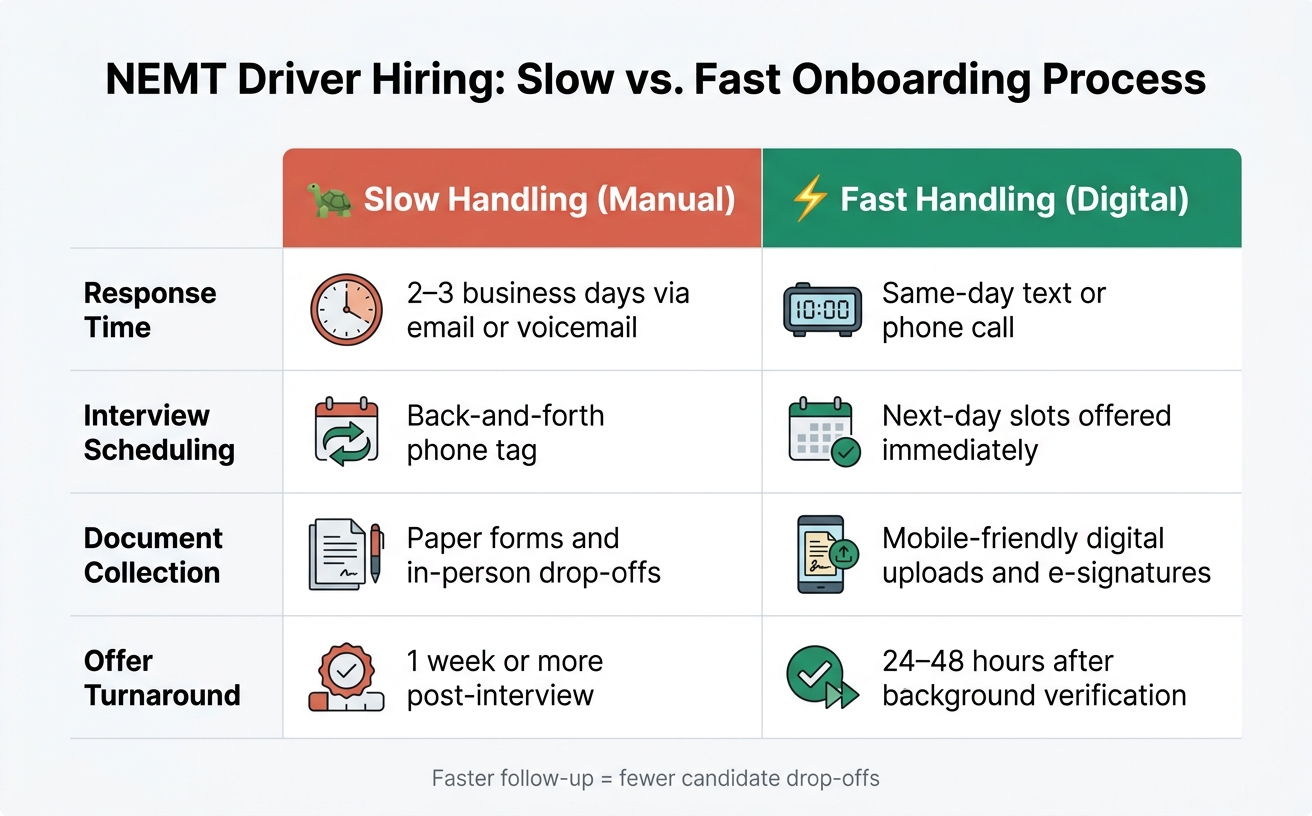
NEMT Driver Hiring: Slow vs. Fast Onboarding Process
Match the recruiting source to the job type
Once local referrals start bringing in leads, the next step is picking the right channel for each role. That choice affects who actually applies. CDL drivers usually come through CDL schools. Non-CDL ambulatory drivers tend to come from community job boards. And drivers with passenger-assistance experience often come from a different hiring pool, usually healthcare support networks.
Each group is looking for different details.
A CDL candidate wants to know if the job involves paratransit or other higher-capacity passenger routes. A driver with passenger-assistance experience wants to know what kind of help riders may need on the job. If both groups get the same message, the pitch gets muddy.
Reply the same day and cut steps from the onboarding process
After you source the right people, follow-up speed becomes the next screening factor. Speed matters. Same-day contact by text or phone helps keep candidates engaged. Add next-day interviews, and you remove two of the biggest drop-off points.
Paperwork can slow things down just as much. Paper forms, office drop-offs, and long email chains add friction. Mobile uploads and e-signatures make it easier for candidates to finish paperwork from their phones.
| Step | Slow Handling (Manual) | Fast Handling (Digital) |
|---|---|---|
| Response Time | 2–3 business days via email or voicemail | Same-day text or phone call |
| Interview Scheduling | Back-and-forth phone tag | Next-day slots offered immediately |
| Document Collection | Paper forms and in-person drop-offs | Mobile-friendly digital uploads and e-signatures |
| Offer Turnaround | 1 week or more post-interview | 24–48 hours after background verification |
Once a candidate says yes, onboarding needs that same level of speed and care. A pilot rollout approach gives new hires a smaller part of the fleet before they move into full assignment. That helps cut early mistakes and gives new drivers time to settle into the work.
Conclusion: Clearer posts, narrower targeting, and faster follow-up fill open seats
The pattern across every tactic is pretty simple: clearer posts, narrower targeting, and faster follow-up.
Precise job posts carry a lot of the load. Spell out whether the role is ambulatory, wheelchair, or stretcher-based so applicants know what the job involves before they apply. That kind of clarity helps with retention, but only if new hires get a steady start.
The first 30, 60, and 90 days often decide whether a hire stays. Stable schedules, clear duties, and steady communication help retention. Early performance tracking also helps you spot drivers who need support before small issues turn into bigger ones. Utilizing NEMT dispatch software features like real-time analytics makes this monitoring seamless.
Reply to applicants the same day. Fleets fill open seats fastest when job posts are specific, role targeting is narrow, and follow-up happens the same day.
FAQs
How can I make my NEMT job posts attract better-fit drivers?
Make your job posts line up with the actual role. Spell out patient mobility needs, such as wheelchair, stretcher, or ambulatory transport. Call out whether the job needs a CDL or non-CDL driver. If you offer sign-on pay, keep it realistic and limited. And if you serve schools, say so clearly and include school-hours expectations.
It also helps to recruit through local referral channels. That includes community networks and referrals from current drivers. Then move fast with follow-up so qualified applicants don’t lose interest.
Where should small NEMT fleets look for drivers first?
The available search results don’t say where small NEMT fleets should look for drivers first.
Instead, they focus on other parts of the business, such as:
- NEMT software features
- Platform comparisons, including NEMT Cloud Dispatch and RouteGenie
- Dispatch and routing setup
So, based on those results alone, there isn’t enough information to point to driver recruitment channels or hiring priorities for small NEMT fleets.
How fast should I follow up with NEMT driver applicants?
In a tight labor market, follow up as soon as possible – ideally the same day. If you wait too long, strong candidates may accept offers from other employers.
A clear process for immediate outreach helps you move faster and keep hiring on track, even when day-to-day service work is pulling your attention in other directions.