
If I had to boil this down to one point, it’s this: the best NEMT routing software doesn’t just build routes – it helps me finish trips with the right vehicle, on time, and with billing records ready to use.
Manual planning can waste 10% to 20% more miles, and route optimization can cut fuel use by 15% to 30%. So when I compare NEMT tools, I look at four things first:
- How they group and sequence trips
- How they handle same-day changes
- How they track GPS, signatures, and mileage
- How well routing connects to billing and Medicaid claims
This comparison covers NEMT Cloud Dispatching, TripMaster, Tobi Cloud, RouteMatch, Bambi, and RouteGenie. In plain terms, some tools are better for small fleets and simple dispatch, while others fit broker-heavy work, multi-county routing, or large multi-state programs.
A fast way to think about it:
- TripMaster and Bambi fit smaller teams
- NEMT Cloud Dispatching and RouteGenie focus on routing and billing flow for mid-size fleets
- Tobi Cloud fits broker-heavy setups
- RouteMatch fits large fleets with stricter dispatch rules
The main takeaway: if your team still re-enters trip data by hand, the routing tool is only doing part of the job.
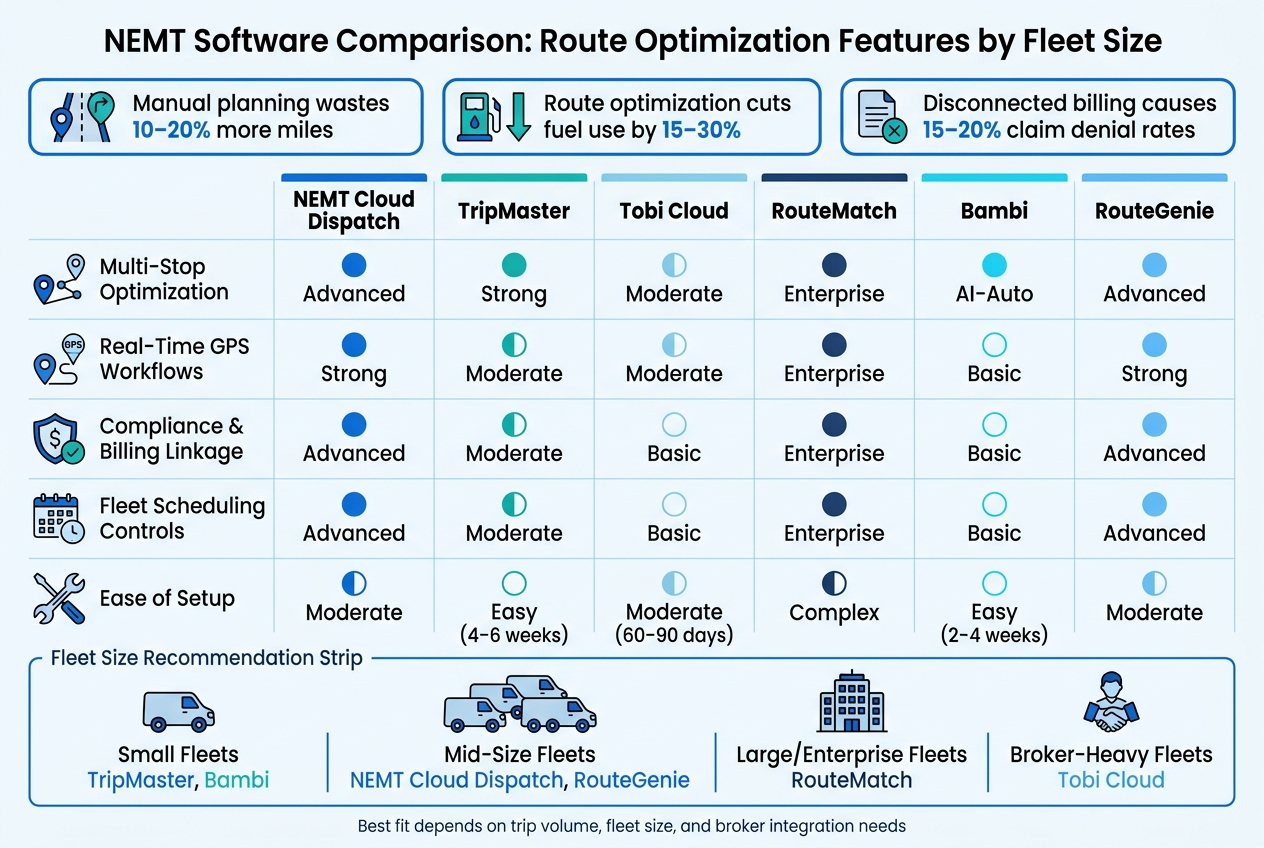
NEMT Software Comparison: Route Optimization Features by Fleet Size
Non-Emergency Medical Transportation (NEMT) Dispatch Planning Demo | NextBillion.ai
sbb-itb-af83355
Quick Comparison
| Platform | Best known for | Best fit |
|---|---|---|
| NEMT Cloud Dispatching | Multi-stop routing, same-day rerouting, billing tie-in | Small-to-mid fleets |
| TripMaster | High-volume scheduling and multi-load dispatch | Smaller fleets or paratransit-heavy teams |
| Tobi Cloud | Broker EDI links and recurring trip handling | Mid-sized broker-heavy fleets |
| RouteMatch | Large-fleet dispatch control and compliance tracking | Multi-state or large enterprise fleets |
| Bambi | Simple AI-based dispatch and easy setup | Mid-size NEMT-only fleets |
| RouteGenie | Multi-load routing and dispatch-to-billing flow | Mid-to-large fleets focused on route use |
If you’re choosing between software and manual dispatch, I’d start with your trip volume, fleet size, and how often dispatch changes during the day.
1. NEMT Cloud Dispatching
NEMT Cloud Dispatching brings NEMT dispatch software features like scheduling and routing into one cloud-based engine, instead of splitting them into separate tools that need to be tied together later.
Multi-Stop Optimization
The platform groups trips that fit well together to get more use out of each vehicle. Before it builds a grouped trip, it checks passenger needs, like wheelchair support or oxygen, to make sure the full load can still be handled. For recurring dialysis trips, standing orders auto-generate each week and adjust for holiday schedules and weather-related closures.
After trips are grouped, the same routing engine sends updates to drivers in real time.
Real-Time GPS Workflows
Routes go straight to the iOS and Android driver app, which includes turn-by-turn navigation. That means drivers don’t have to jump over to a separate GPS app. If a driver calls out or a broker adds a same-day trip, the system re-optimizes fast and pushes updated manifests to the drivers affected. The app also records GPS timestamps, electronic signatures, and odometer readings at pickup and drop-off.
Compliance and Billing Linkage
Broker service-level agreements and ADA pickup windows are handled as fixed constraints. So the optimizer doesn’t suggest routes that would miss required service windows. After the trip is done, GPS-verified trip data moves into billing, which cuts down on manual claim work.
And it doesn’t stop at live dispatch. The platform also handles back-office scheduling rules.
Fleet Scheduling Controls
Dispatchers can use a scenario planner to test what happens if they add a new contract or shrink fleet size before they change capacity or take on new contracts. The engine also applies driver shift limits, required breaks, and certification rules during route building.
2. TripMaster
TripMaster is built for high-volume scheduling and paratransit dispatch, which makes it a solid benchmark for multi-stop route planning. If NEMT Cloud Dispatching leans into one cloud-based routing setup, TripMaster is the more established pick for heavy scheduling loads and broker-linked dispatch.
Multi-Stop Optimization
TripMaster’s auto-scheduler can process about 100 rides per minute, so it works well for providers moving a large number of trips each day. It supports multi-load routing and high-volume dispatch across multi-county operations.
Its main edge is bulk scheduling and multi-load routing. It isn’t built around the deepest constraint-heavy optimization logic. For teams that care more about throughput than fine-tuned routing rules, that can be a good tradeoff.
Real-Time GPS Workflows
TripMaster brings GPS tracking into the dispatch interface, so dispatchers can see live vehicle locations and on-time status updates in one place. That kind of visibility helps when schedules get busy and small delays start stacking up.
That said, some users have reported occasional GPS issues and brief outages.
Compliance and Billing Linkage
TripMaster also connects routing with broker workflows, which matters when trip status needs to move cleanly into billing. TripMaster integrates with Modivcare, Alivi, and OneCall through its Premier Partner status. That supports tighter status syncing and automated trip imports, which helps keep routes lined up with broker documentation and claim-ready dispatch records.
The platform also integrates with MedBatch for Medicaid billing, linking dispatch records to claims without a separate export step.
Fleet Scheduling Controls
TripMaster handles both NEMT and paratransit in one system, making it a practical choice for public transit agencies that run both program types. Implementation usually takes 4 to 6 weeks and calls for staff training because the system has a lot of configuration depth.
3. Tobi Cloud
Tobi Cloud, formerly NovusMED Tobi, is built around built-in EDI links with major brokers like ModivCare and MTM. It’s aimed at mid-to-large fleets, usually 10 to 200 vehicles, that handle a high volume of broker trips. Its edge isn’t just route speed. It’s the way those routes stay lined up with broker EDI and billing.
Multi-Stop Optimization
Tobi’s routing engine automatically groups riders who are going to the same facility within similar time windows. Before it suggests a multi-stop route, it checks whether mobility needs – such as wheelchair securement, oxygen, or escort support – fit together across the grouped passengers. It also checks that the grouped trips stay claim-ready for broker billing.
Real-Time GPS Workflows
When traffic, road closures, call-outs, or same-day broker-added trips throw off a route, Tobi reruns optimization and sends updated manifests and navigation to the driver app. If there’s a no-show or cancellation, it recalculates the rest of the route and sends status updates back to the broker through EDI.
Compliance and Billing Linkage
The driver app records GPS location logs, pickup and drop-off timestamps, electronic signatures, and odometer readings for billing, 837P claims, invoicing, and EVV reporting. That flow cuts manual admin work by keeping route records and compliance documents aligned from dispatch through claim submission. The same routing rules also guide standing orders and recurring-trip assignments.
Fleet Scheduling Controls
Tobi supports standing orders for recurring trips like dialysis or cancer therapy, automatically creating trip instances with the right vehicle and driver assignments. It also enforces fixed constraints such as ADA pickup windows, broker SLA windows, vehicle-specific equipment needs, driver shift lengths, mandatory breaks, and overtime thresholds.
Implementation usually takes 60 to 90 days, including broker EDI activation and dispatch training.
The next platform shifts the comparison from broker-heavy integration to broader dispatch operations.
4. RouteMatch
Where Tobi Cloud leans into broker-linked routing, RouteMatch puts the spotlight on enterprise compliance and dispatch control across multiple states. It’s aimed at larger operators, usually fleets with 150 or more vehicles running multi-state service, and it can support about 60 to 300+ trip legs per day.
Multi-Stop Optimization
RouteMatch uses medical-trip routing logic to line up shared rides around appointment windows while factoring in wheelchair loading time and ride-time limits. It also accounts for vehicle-level capacity for ambulatory, wheelchair, and stretcher trips when it builds routes.
Real-Time GPS Workflows
The platform records GPS location pings and flags late arrivals against the manifest in real time. If a route starts to slip, RouteMatch can re-optimize the remaining stops while still keeping ride-time and wheelchair loading limits in place. Status updates, including no-shows and will-call confirmations sent back to brokers, can also flow to Modivcare, MTM, and Veyo through broker EDI integration.
Compliance and Billing Linkage
Completed trip data, including GPS timestamps, signatures, mileage, and odometer readings, can flow straight into an EDI 837 claims engine. RouteMatch also integrates with enterprise clearinghouses like Waystar for denial management. In plain terms, that makes the billing trail easier to audit at scale. Claims, signatures, and trip records stay lined up without manual re-entry.
Fleet Scheduling Controls
RouteMatch tracks CPR, PASS, and defensive driving credentials along with vehicle inspection logs. That means vehicles and drivers aren’t cleared for dispatch when credentials have expired. Credential status becomes part of route readiness instead of a separate back-office check.
5. Bambi
Bambi is built for mid-size NEMT-only fleets. It leans on an AI-driven dispatch engine and a simple interface, which shifts the comparison toward easier automation for smaller teams.
Multi-Stop Optimization
Bambi’s main routing feature, Run Bambi Run, automatically assigns trips and builds the daily manifest. It also supports multi-load routing, so operators can combine trips without manually juggling every stop sequence.
Real-Time GPS Workflows
Bambi’s driver mobile app helps dispatchers and field staff stay in sync throughout the day. It also supports real-time trip changes, which can make day-to-day dispatch less of a scramble.
That said, its GPS tracking is more basic than what you’ll find in enterprise systems. If your team depends on deeper tracking detail, it’s worth checking whether Bambi’s setup lines up with your workflow needs.
Compliance and Billing Linkage
Completed trips flow into billing, but Bambi’s rules engine is lighter than enterprise systems. That means providers dealing with complex Medicaid documentation or state-specific billing modifiers may need more manual review.
It can work well for operators managing both Medicaid broker trips and private-pay contracts. But for larger organizations with strict compliance demands, it offers less room for configuration.
Fleet Scheduling Controls
Bambi’s AI engine builds the manifest, but the scheduling controls are simpler than enterprise-grade systems. Implementation usually takes 2 to 4 weeks, which is faster than many enterprise platforms that can take 4 to 6 weeks to go live.
That simpler control set makes Bambi a solid fit for growing fleets, rather than highly complex enterprise operations.
6. RouteGenie
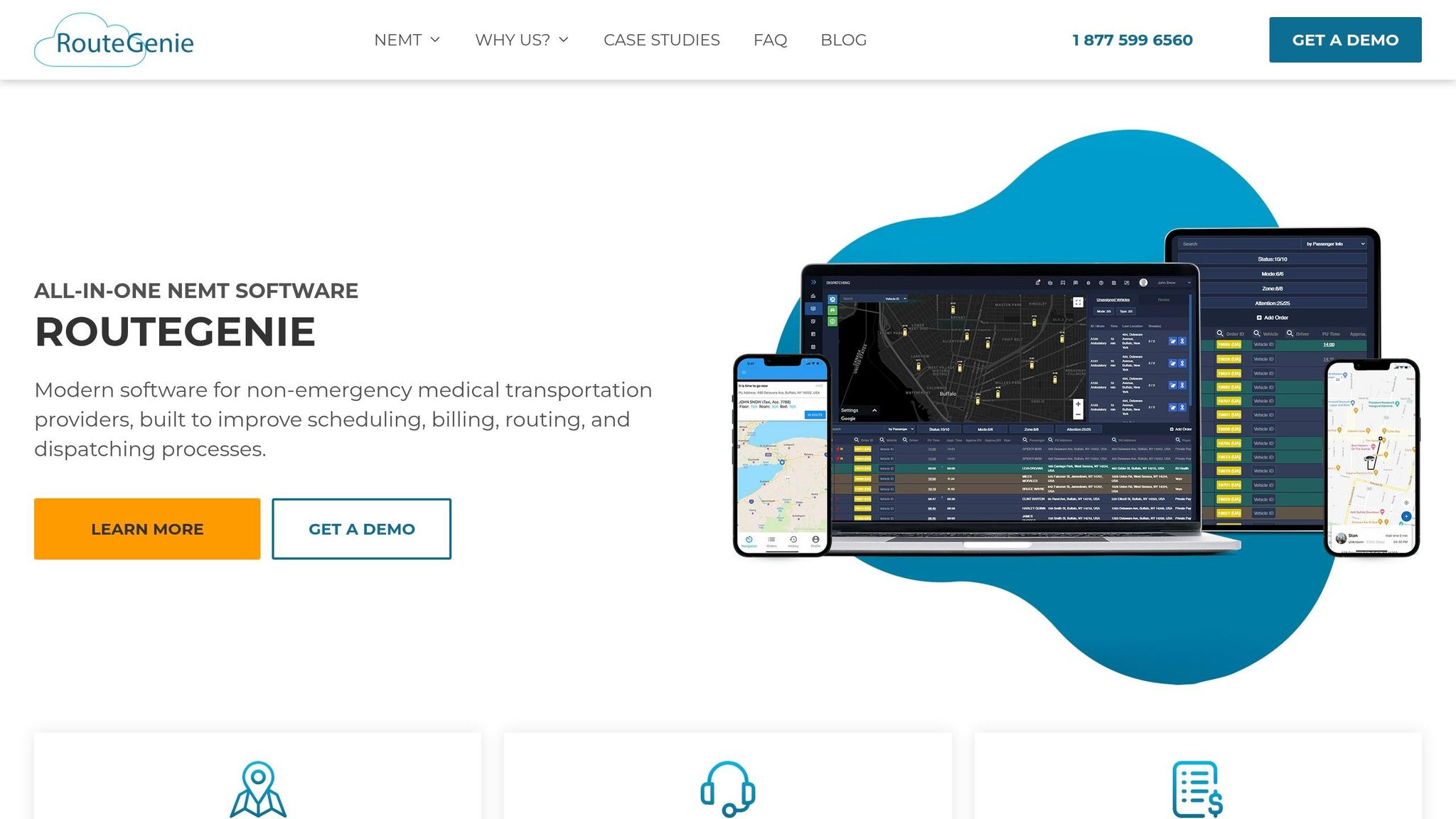
RouteGenie is a platform for mid-to-large fleets that centers on multi-load routing and dispatch.
Multi-Stop Optimization
RouteGenie’s multi-load routing engine groups compatible trips into multi-stop routes in seconds. It factors in real-time traffic, driver absences, and cancellations as it builds those routes. It also handles standing orders, like recurring dialysis trips, and fits them in with one-time rides so vehicles stay busy across the day. On top of that, the platform matches each passenger’s mobility needs with the right vehicle ramp or securement setup. That same routing logic also carries over to dispatch updates and day-of changes.
Real-Time GPS Workflows
With its dispatch dashboard and driver app, dispatchers can talk with drivers in real time and reroute vehicles on the spot as the day shifts. Those changes don’t stay stuck in dispatch, either. They also flow into billing and claim records.
Compliance and Billing Linkage
Completed trips send GPS-verified timestamps and signatures into BillingGenie to automate 837P and CMS 1500 forms.
Fleet Scheduling Controls
Before a trip gets assigned, RouteGenie checks passenger mobility needs, vehicle start locations, and driver qualifications. That extra control can make a big difference at scale. RouteGenie customers have reported completing 25% more trips with the same fleet size, and some have taken as much as 20% of their fleet off the road while keeping trip volume the same.
The catch? RouteGenie usually takes more setup and training than simpler cloud-based or on-premise platforms. You’ll see that gap more clearly in the feature-by-feature comparison below.
How These Platforms Differ Across Key Features
These six platforms fall into two camps: faster routing with lighter controls and deeper optimization tied to compliance and billing.
The biggest gaps show up in three places: how they sequence stops, how they reroute during the day, and how tightly they enforce trip rules.
Multi-stop optimization is where the spread is widest. NEMT Cloud Dispatching and RouteGenie lean into fast re-optimization, which matters when same-day changes start piling up. TripMaster is stronger with high-volume multi-load routing. RouteMatch is built for large enterprise dispatch teams that deal with more moving parts. Bambi leans hard on automated assignment, while Tobi Cloud keeps routing lighter and easier to manage.
Compliance and billing linkage is another area where differences become obvious fast, especially in Medicaid work. When billing sits apart from dispatch and staff have to re-enter trip data by hand, claim denial rates average 15–20%. That’s a painful leak. Platforms like NEMT Cloud Dispatching and RouteGenie turn completed trip records – including GPS timestamps and electronic signatures – into EDI 837P claims automatically. TripMaster does offer Medicaid billing modules, but its rules engine for more complex state-specific Medicaid programs is more limited.
The table below compares the platforms across the four areas that tend to shape day-to-day dispatch the most:
| Feature | NEMT Cloud Dispatching | TripMaster | Tobi Cloud | RouteMatch | Bambi | RouteGenie |
|---|---|---|---|---|---|---|
| Multi-Stop Optimization | Advanced route optimizer; handles same-day add-ons and recurring trips | Strong multi-load support for established fleets | Simplified routing for broker-heavy fleets | Enterprise-scale multi-stop dispatch | AI auto-assignment; minimal manual input | High focus on multi-loading |
| Real-Time GPS Workflows | Continuous re-optimization; pushes updates to drivers in seconds | Dynamic scheduling with audit trail focus | Simplified dispatch tools | Enterprise-scale multi-stop dispatch and EVV integration | Automated trip assignment | Instant rerouting through dispatcher-driver communication |
| Compliance & Billing | ADA/Medicaid rules enforced at scheduling; automated 837P generation | Medicaid billing modules; basic rules engine | Basic trip documentation | Robust compliance for multi-state programs | Automation-focused | Integrated billing and trip verification data |
| Fleet Scheduling Controls | Specialty equipment matching; “what-if” scenario planning | Mid-market scheduling tools | Basic vehicle assignment | Complex multi-fleet controls | Automated driver-trip matching | Passenger mobility matched to vehicle type |
| Best Fit | Small-to-mid fleets and multi-service operators | Small fleets transitioning from spreadsheets | Mid-sized broker-heavy fleets | Large, multi-state enterprises | Operators prioritizing automation | Mid-size fleets prioritizing routing efficiency |
Fleet scheduling controls follow the same pattern. Higher-end systems check vehicle type, rider mobility needs, and driver credentials before a trip is dispatched. Simpler platforms can speed up assignment, but they tend to leave more for staff to review by hand.
Pros and Cons by Platform
Every platform gives you a different mix of routing power, speed, ease of use, and integration depth. The table below narrows that down to what matters most during day-to-day dispatch.
| Platform | Pros | Cons |
|---|---|---|
| NEMT Cloud Dispatching | Automated multi-load routing; real-time re-optimization for same-day changes; specialty equipment matching | Routing depth for highly complex programs should be verified before committing |
| TripMaster | Simple interface; easy onboarding for operators moving off spreadsheets; dedicated multi-load support and dynamic scheduling for small fleets | Basic optimization engine; not well-suited for dialysis-heavy or multi-county programs; limited EHR integration |
| Tobi Cloud | Clean UI; better fit for broker-heavy teams that want simpler dispatch workflows | Limited rules engine for complex Medicaid billing; lacks deep integration maturity for Medicaid-heavy providers |
| RouteMatch | Enterprise-scale dispatch; handles ADA requirements and multi-service agency needs across large networks | Complex UI; too much for small fleets; integrations often need custom configuration |
| Bambi | Easy to use; strong driver app experience | Broker integration depth varies by contract; some trips still need manual edits |
| RouteGenie | Robust cost-per-trip analytics; automated multi-loading that can reduce fleet overhead; strong trip verification features | Limited EHR connectivity for hospital discharge planning; state Medicaid rules vary by deployment |
These gaps tend to show up first in reroutes, trip verification, and claim-ready records. That’s where the trade-off becomes plain: some tools are easier to pick up, while others give dispatchers tighter control over routing.
The other issue is manual work. When scheduling and billing live in separate systems, staff end up re-entering the same trip data, and that opens the door to claim denials. Platforms that connect trip records directly to claims usually cut down that burden.
For most fleets, the first filter is route volume and how often the schedule shifts during the day. Fleet size is usually the fastest way to narrow the list:
- TripMaster or Bambi for smaller fleets
- NEMT Cloud Dispatching or RouteGenie for mid-size fleets
- RouteMatch for larger multi-county operations
Conclusion
In NEMT, routing matters most when it ties together dispatch, driver workflow, and billing. The main goal isn’t just a fast route. It’s a completed, claim-ready trip that moves from dispatch to billing without re-entry. That’s why platform fit matters more than route speed by itself.
Enterprise fleets often lean toward RouteMatch. Smaller providers tend to look at TripMaster or Bambi. Broker-heavy operations usually fit Tobi Cloud better. And mid-size fleets that care most about optimization often prefer platforms with tighter routing and billing linkage. In practice, the big difference comes down to how much routing control and billing linkage your operation needs.
Disconnected billing still leads to avoidable claim denials and manual rework.
Before you choose a platform, map your trip lifecycle:
- Where data gets re-entered
- Where claims fail
- Whether broker connections run through APIs or CSV imports
Then pick the platform that removes the most manual steps between trip creation and claim submission.
FAQs
How do I choose the right NEMT routing software for my fleet size?
Match the software to your workflow and the gaps that slow you down. Start with the basics: your daily trip volume, your claim denial rate, and whether you manage direct bookings or broker-heavy, multi-load schedules.
For small to mid-size fleets, all-in-one cloud platforms like NEMT Cloud Dispatching can cut down on manual re-entry. Bigger operations may need more room to tailor the system to the way they work. During any demo, check for real-time re-optimization, broker EDI integration, migration support, ongoing support, and EVV data capture for clean claims.
What features matter most for same-day trip changes?
The features that matter most are real-time rerouting, live vehicle tracking, and instant dispatcher-driver communication.
A good platform should also slot in last-minute broker requests or emergency pickups to existing manifests without forcing dispatchers to rebuild the entire schedule from scratch. That can save a lot of time when the day goes sideways.
Tools like NEMT Cloud Dispatching can also check vehicle and driver availability on their own, which cuts down on manual work when traffic, driver absences, or new service requests throw off the plan.
How does route optimization reduce billing errors?
Route optimization cuts billing errors by sending key trip details straight from dispatch into billing. That includes GPS timestamps, mileage, pickup and drop-off times, and electronic signatures.
The big win is simple: no manual re-entry. And that matters because retyping trip data is a common reason for claim denials and missing paperwork.
When systems don’t talk to each other, errors tend to creep in during handoffs. With modern NEMT routing platforms like RouteGenie, providers can build billing records from verified trip activity.