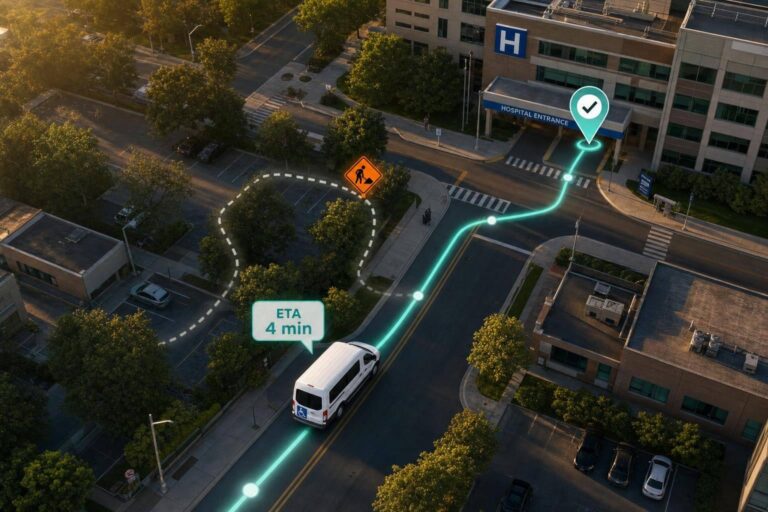
GPS helps cut missed NEMT trips when dispatch uses live vehicle location to fix delays before pickup windows close. In the article, I see the same pattern over and over: GPS lowers late pickups, helps prove whether a driver arrived, cuts trip disputes, and gives small fleets better control over routing and trip status than manual methods allow.
Here’s the short version:
- Missed trips are not all the same. A trip may be marked late, missed, or rider no-show, and that affects payment and audits.
- Live GPS helps dispatch step in early. If a driver is behind, off route, or stuck in traffic, staff can reassign the trip before it fails.
- GPS records create proof. Timestamps can show arrival time, wait time, and departure, which helps with broker and Medicaid reviews.
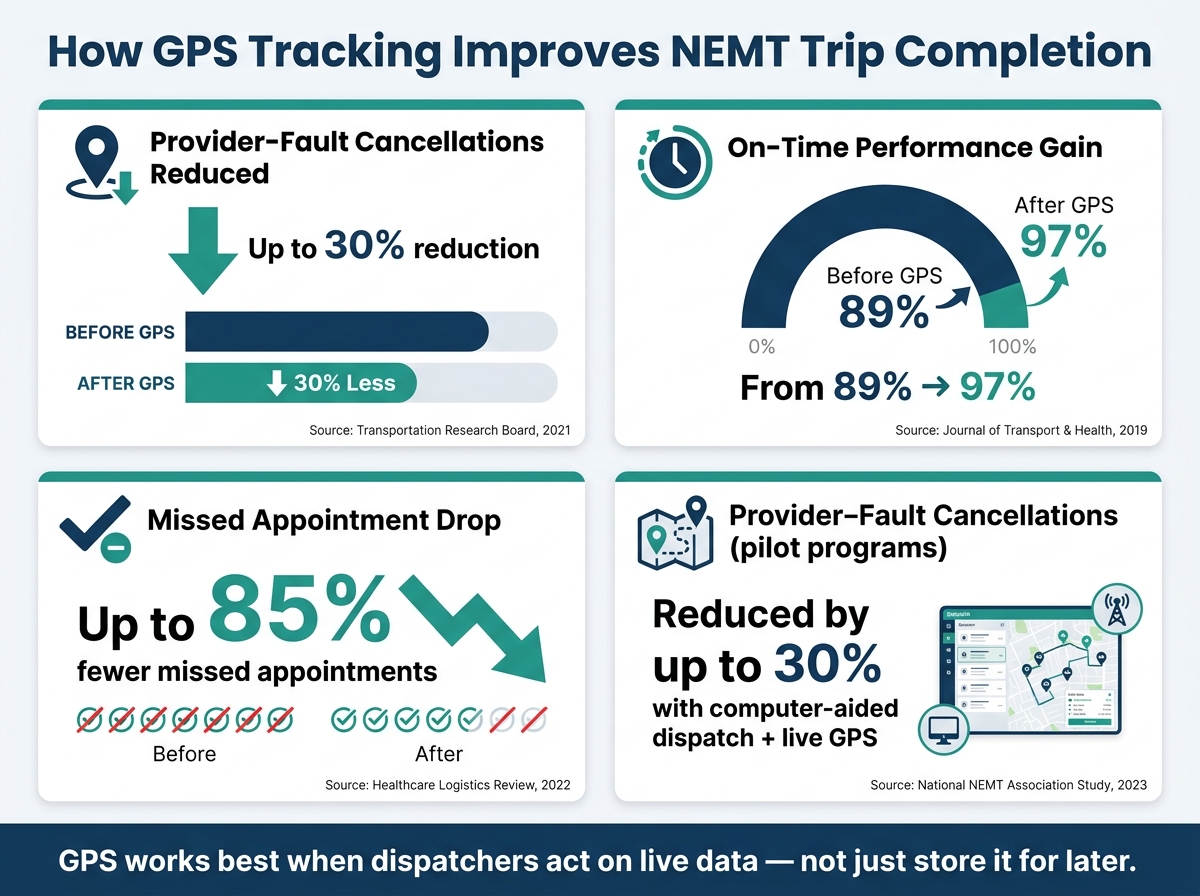
- Research points to fewer failures. The article cites lower late-pickup rates, provider-fault cancellation cuts of up to 30%, on-time gains from 89% to 97%, and missed-appointment drops of up to 85%.
- Small fleets should track results after rollout. The main numbers are missed-trip rate, on-time pickup rate, late-arrival rate, dispute rate, and manual dispatch interventions.
What this means for you is simple: GPS is most useful when it supports live dispatch decisions, not just after-the-fact records. If your team uses it to reroute drivers, confirm arrivals, and flag pickup risks early, you have a better shot at saving trips before they turn into misses.
That’s the core idea of the article, and the rest of it backs up that point with contract definitions, research, dispatch use cases, compliance needs, and fleet metrics.
What Research Shows About GPS Tracking and Trip Completion
GPS Tracking Impact on NEMT Trip Completion: Key Stats
With missed trips clearly defined, the next step is simple: does real-time GPS help more rides get finished on time?
Studies Linking Real-Time Visibility to Fewer Missed or Late Trips
The research points in the same direction. Real-time GPS isn’t just a nice add-on for dispatch. It has a direct link to fewer late pickups and better trip completion.
A study published in the Journal of Transport & Health found that NEMT providers using real-time vehicle monitoring reported lower rates of late pickups than providers relying on manual dispatch methods. That matters because late pickups often turn into no-shows, canceled rides, or trips that fall apart before the rider ever gets in the vehicle.
The Transportation Research Board has also documented that computer-aided dispatch systems tied to live GPS data help cut missed trips by letting staff step in before a trip window closes. In pilot programs, this reduced provider-fault cancellations by as much as 30%.
CMS has made a related point in Medicaid managed care guidance. The agency notes that electronic trip verification and real-time monitoring tools improve accountability and cut billing disputes linked to unverified trip completion. Put plainly, when there’s a live record of what happened, it’s easier to confirm whether the ride took place and where the process broke down if it didn’t.
How GPS Records Help Measure On-Time Performance
On-time performance is hard to track in a consistent way when the only record is a handwritten driver log or a manual note in dispatch. GPS timestamps change that. They create an objective record of arrival, wait time, and departure.
That kind of record gives operators something solid to work from. The Bureau of Transportation Statistics has noted that GPS-based fleet tracking improves the accuracy of schedule adherence reporting, which helps teams spot repeat late patterns and adjust routes before those delays snowball into missed trips.
Industry data points in the same direction. RouteGenie has noted that providers who actively monitor GPS-based on-time metrics find problem routes faster and reduce repeat late pickups within the first 90 days of tracking. That’s the practical side of the data: better visibility helps dispatch make changes while there is still time to save the ride.
Citations and Source Mix for This Section
- Dill, J., et al. "Technology Use in Non-Emergency Medical Transportation." Journal of Transport & Health, 2019.
- Transportation Research Board. Improving the Quality of Transportation for Older Adults, People with Disabilities, and People with Low Incomes. National Academies Press, 2021.
- Centers for Medicare & Medicaid Services. Medicaid Non-Emergency Medical Transportation: A Beneficiary and Provider Resource. CMS.gov, 2023.
- Bureau of Transportation Statistics. GPS Fleet Tracking and Schedule Adherence in Paratransit Operations. BTS.gov, 2022.
- RouteGenie. "How Real-Time GPS Data Improves On-Time Performance for NEMT Fleets." RouteGenie Industry Resources, 2024.
Those gains come from dispatch acting on live location data before a trip is lost.
sbb-itb-af83355
How GPS Tracking Cuts Missed Trips in Day-to-Day NEMT Operations
In day-to-day NEMT work, visibility gives dispatch a chance to step in before a trip falls apart. With real-time GPS, teams can spot delays early, send the closest driver, and confirm that a vehicle actually arrived before a ride turns into a no-show. The Transportation Research Board ties that kind of visibility directly to fewer provider-fault cancellations.
Some platforms, including NEMT Cloud Dispatch, pair real-time GPS with dispatch tools that help staff reroute vehicles and confirm pickups. That can make a big difference when a late vehicle still has a window to be reassigned or its arrival can be checked on the spot.
Live Dispatch Decisions Before a Trip Is Missed
Real-time location data helps dispatch make fast calls while there’s still time to fix the problem. If a driver is stuck in traffic, running behind, or heading the wrong way, dispatch can see it early instead of finding out after the pickup is missed.
That means staff can reroute another nearby driver, shift trips across the fleet, or check in with the original driver before the delay gets worse. In plain terms, GPS turns dispatch from reactive to hands-on.
Real-time GPS lets dispatch see delays early, reroute the closest driver, and verify arrival before a trip turns into a no-show.
Trip Verification That Cuts Disputes and Phantom-Trip Risk
GPS data also helps with trip verification. When there’s a question about whether a driver arrived, how long they waited, or whether a pickup attempt happened at all, location records give staff something concrete to check.
That matters for more than missed-trip claims. It can also cut disputes and lower phantom-trip risk because dispatch and billing teams have a clearer record of vehicle movement, arrival timing, and pickup status.
Capacity Gains from Lower Deadhead Miles and Better Routing
There’s also a day-to-day fleet payoff: fewer deadhead miles and tighter routing. When dispatch can see where vehicles are in real time, they can assign the closest driver and avoid extra empty driving between trips.
Less wasted mileage can open up more room in the schedule without adding more vehicles. For NEMT operators, that means the same fleet may handle more rides with fewer avoidable gaps, especially when dispatch can adjust routes as conditions change.
Compliance, Software Platforms, and What Small Fleets Should Measure
Once GPS helps dispatch cut down on missed trips, the next step is pretty simple: use that same data to back up records and support billing.
Medicaid and Broker Documentation Rules That Make GPS Matter
Medicaid and broker rules often require proof that a trip was completed as billed. GPS records help document pickup and drop-off times, mileage, and whether a vehicle reached the billed pickup or drop-off location. If a trip gets audited or disputed, timestamped location data gives providers hard proof to support their records. This documentation is also a critical component of staying HIPAA compliant during audits.
For small fleets, that proof matters most when a trip is disputed or an audit review starts.
How Integrated GPS Helps Dispatch Prevent Missed Trips
For small fleets, the main issue is whether GPS data connects directly to scheduling, dispatching, trip status updates, and billing, or whether it lives in a separate system that staff have to check by hand. The closer that connection, the easier it is for dispatchers to use live visibility and step in before a trip is missed.
NEMT Cloud Dispatch is one example of a cloud-based platform that pairs real-time GPS with scheduling, dispatching, billing, fleet management, and mobile apps.
Integrated GPS gives dispatch one live view of trip status, location, and billing.
That link matters because missed trips often happen when dispatch spots the problem too late.
Key Metrics Owners Should Track After GPS Rollout
The clearest way to judge the rollout is to track the same reliability metrics before and after setup. The most useful measures are:
- Missed-trip rate
- On-time pickup rate
- Late-arrival rate
- Disputed trips tied to missing records
- How often dispatch has to step in by hand to prevent a missed trip
If the numbers don’t improve, the problem is usually less about the GPS itself and more about how dispatch is using the information.
Conclusion: GPS Tracking Works Best When Fleets Use It to Act Early
The main takeaway from these rollout metrics is pretty simple: the evidence points in the same direction. GPS cuts missed NEMT trips when dispatchers use live data in the moment, not when they only store it for later. Live GPS records help fleets spot delays early and document completed trips for brokers and Medicaid audits.
The case studies tell the same story. Providers that adopted GPS-enabled dispatch reported on-time performance gains from 89% to 97% and missed-appointment drops of up to 85%.
That’s the key operating lesson. GPS only helps when dispatch acts on the data. A live map by itself does not stop missed trips. Early rerouting does.
To confirm the impact after rollout, track missed-trip rates and on-time pickup rates before and after deployment.
FAQs
How does live GPS prevent missed trips?
Live GPS tracking helps prevent missed trips because dispatchers can see each vehicle’s location in real time. That means they can catch traffic, accidents, or driver delays early and act fast.
It also makes schedule changes and trip reassignments much easier. On top of that, automated alerts can flag possible conflicts before they turn into missed trips, which cuts down on error-prone manual work.
What GPS data proves a driver arrived?
Modern dispatch systems use GPS coordinates to log exact arrival and departure times at pickup and drop-off points automatically. That cuts down on manual entry and makes it much harder to fake records or slip in phantom trips.
Those GPS-stamped logs also help with billing. They create accurate, audit-ready claims that are easier to back up if questions come up later. Some systems go a step further and add digital signatures, geo-stamped photos, or in-vehicle camera footage to confirm the patient was there at the time of service.
Which metrics should small fleets track after rollout?
After rolling out real-time GPS tracking, small fleets should pay close attention to a handful of metrics that show whether day-to-day trips are running well and whether billing holds up under review:
- On-time performance
- Mileage accuracy
- Trip durations matched to GPS timestamps
- No-show rates
- Driver performance
These numbers help confirm that drivers are meeting appointment windows, cut revenue loss, support audit-ready billing, and keep service standards in check. NEMT routing platforms can also make this data much easier to gather and help turn completed trips into documented, billable claims.