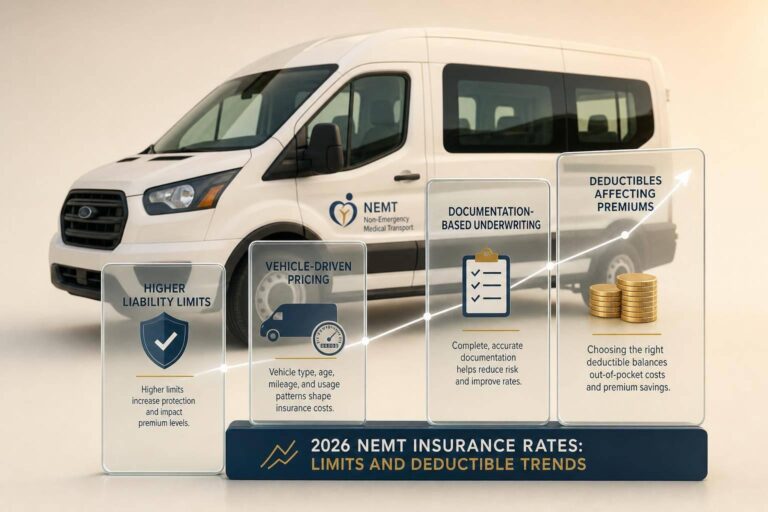
NEMT insurance in 2026 is getting tighter: higher contract limits, closer review of claims, and more focus on records. If you run a small or midsize fleet, even one claim, one urban route, or one stretcher unit can change what you pay.
Here’s the short version:
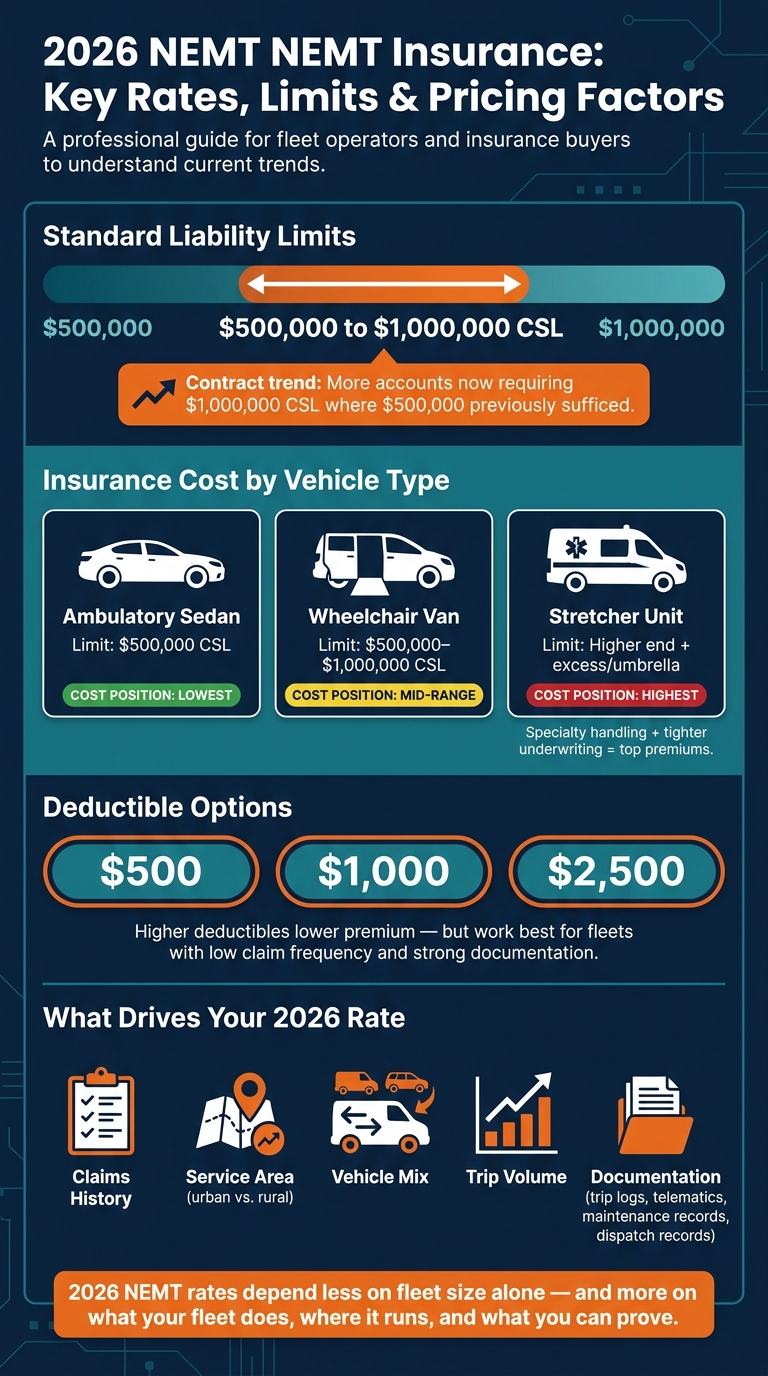
- Most fleets carry $500,000 to $1,000,000 CSL
- Some contracts now want $1,000,000 CSL where $500,000 used to work
- Sedans usually cost the least to insure
- Wheelchair vans sit in the middle
- Stretcher units usually cost the most
- Common physical damage deductibles are $500, $1,000, and $2,500
- Higher deductibles can cut premium, but mostly for fleets with low claim frequency
- Insurers now put more weight on trip logs, maintenance files, telematics, and dispatch software features —often managed via NEMT software vs. manual dispatch systems—
If I had to sum it up in one line, it would be this: 2026 NEMT rates depend less on fleet size alone and more on what your fleet does, what it drives, where it runs, and what you can document.
| Area | What 2026 looks like |
|---|---|
| Liability limits | $500,000 to $1,000,000 CSL is common |
| Contract trend | More accounts moving toward $1,000,000 CSL |
| Lowest-cost vehicle | Ambulatory sedan |
| Mid-range vehicle | Wheelchair van |
| Highest-cost vehicle | Stretcher unit |
| Common deductibles | $500, $1,000, $2,500 |
| Main pricing factors | Claims, service area, trip volume, vehicle mix, records |
So before you look at a quote, focus on the levers that matter most: limits, deductibles, vehicle type, claim history, and recordkeeping. That’s where most 2026 rate movement starts.
2026 NEMT Insurance Rates by Vehicle Type & Coverage Limits
Baseline 2026 NEMT Coverage Limits and Per-Vehicle Cost Ranges
Standard Liability Limits in NEMT Contracts
In 2026, many NEMT fleets carry $500,000 to $1,000,000 CSL. That usually comes down to Medicaid broker rules and state contract minimums. General liability often sits next to the auto policy as part of the basic insurance setup.
If a fleet operates in more than one state, it usually has to meet the strictest active contract requirement. And that bar is moving up. In 2026, baseline limits are trending higher, with some contracts now calling for $1,000,000 CSL where $500,000 used to be enough.
Once limits are set, carriers turn to vehicle type. That’s often the next big factor that shapes price.
Premium Baselines by Vehicle Type
The same liability limit can cost a lot more or less depending on the vehicle on the policy.
| Vehicle Type | Typical Limit Carried | Typical Premium Position |
|---|---|---|
| Ambulatory sedan | Commonly $500,000 CSL | Lowest |
| Wheelchair van | Commonly $500,000 to $1,000,000 CSL | Mid-range |
| Stretcher unit | Often at the higher end, with excess/umbrella coverage | Highest |
Sedans tend to cost the least because they’re standard passenger vehicles. Wheelchair vans sit in the middle since conversion equipment pushes up replacement value. Stretcher units usually start at the top end because they involve specialty handling and face tighter underwriting.
Total annual cost can also climb when you add other coverages, such as:
- Physical damage
- Uninsured/underinsured motorist
- Hired/non-owned auto
- Cargo coverage
For wheelchair vans and stretcher units, physical damage coverage deserves a close look. Accessibility equipment can push physical-damage premiums higher, sometimes more than operators expect.
sbb-itb-af83355
How Insurers Price NEMT Fleet Risk in 2026
Once limits are set, insurers look at the fleet’s exposure and put a price on that risk. In 2026, NEMT pricing leans more on exposure and loss history than on company size by itself.
That means the quote usually comes down to a handful of factors: fleet size, trip volume, claims history, urban service area, and vehicle mix. A fleet with more vehicles, more rides, and a tougher claims record will often pay more, even if the business itself isn’t that large.
Good records can help here. Clean dispatch logs, trip records, and maintenance files give underwriters a clearer picture of how the fleet runs day to day. And when that picture looks orderly and well-managed, it can support better underwriting.
Higher deductibles can still bring premium costs down. But those savings tend to matter most for fleets with low claim frequency. If claims happen often, the tradeoff may not work out as well.
Deductible Trends in 2026: When Raising Deductibles Still Lowers Premium
Common Deductible Levels and Where Carriers Allow Changes
For physical damage coverage, the most common 2026 deductibles are $500, $1,000, and $2,500. Liability deductibles, on the other hand, are usually fixed or capped pretty tightly. So there’s not much room to move them.
That’s why deductible choice is still one of the few pricing levers operators can control.
When Higher Deductibles Save Money and When They Do Not
The main question is simple: does the premium drop enough to make up for the extra out-of-pocket risk?
Higher deductibles tend to make more sense for:
- Older vehicles
- Fleets that can handle more loss exposure
Underwriters tend to give more credit when a deductible change comes with strong telematics, solid maintenance records, and clean dispatch records.
If those pieces are in place, a higher deductible can still lower premium. If they’re not, the savings may be too small to justify the added claim exposure.
Risk Controls, Software Records, and 2026 Limit Decisions
How Telematics, Maintenance Logs, and Dispatch Records Help With Underwriting
After deductible levels, underwriters usually want to see one thing: proof that the fleet manages day-to-day risk.
In 2026, deductible and limit pricing depends on more than fleet size alone. Insurers now look at operational records to check the risk profile behind those factors, including fleet size, claims history, service area, vehicle mix, and documented risk controls.
That means underwriters often review records tied to:
- driver supervision
- maintenance
- telematics
- trip logs
- dispatch logs
NEMT Cloud Dispatch and similar platforms can centralize trip logs, dispatch records, and fleet data, which makes it easier to keep records complete and up to date.
Why does that matter? Because 2026 renewal decisions are leaning more on what a fleet can prove, not just what it can say. Complete records can help support a case for higher limits and lower deductibles at renewal.
Conclusion: What NEMT Operators Should Expect From 2026 Rates
In 2026, underwriting is becoming more documentation-driven. Fleets that can show steady driver supervision, maintenance logs, telematics data, incident reports, and trip and dispatch logs are in a stronger position to support the limits and deductible structure they want. Operators with missing or incomplete records will likely have fewer choices at renewal.
Citations:
- Centers for Medicare & Medicaid Services (CMS). Medicaid Non-Emergency Medical Transportation. https://www.cms.gov/medicare-medicaid-coordination/fraud-prevention/medicaid-integrity-education/downloads/nemt-booklet.pdf
- NEMTAC. NEMT Industry Standards and Accreditation Resources. https://www.nemtac.org
- Bureau of Transportation Statistics. Transportation Statistics Annual Report. U.S. Department of Transportation. https://www.bts.gov
- NEMT Cloud Dispatch. Platform overview and features. https://nemtdispatching.com
- RouteGenie Blog. How Operational Data Supports NEMT Fleet Management and Risk Documentation. https://routegenie.com/blog
FAQs
Will my contract require $1,000,000 CSL in 2026?
It depends on your contract, client rules, and state law – not one nationwide rule. NEMT providers often need more liability coverage than a standard personal auto policy.
If you work under a municipal or Medicaid contract, the agency may set specific minimum limits, including $1,000,000 CSL. Read your contract closely, because the contracting agency or even your lender may require those limits.
How much can a higher deductible lower premium?
Raising your deductible usually lowers your premium because the insurer is on the hook for less.
In 2026, moving a deductible from $500 to $1,000 will often trim collision and comprehensive premiums by about 10%. For many fleets, that works out to roughly $200.00 to $280.00 per year.
That said, repair bills for modern vehicles keep climbing. So for high-value fleets, a lower deductible can still be the smarter call. A simple rule of thumb: pick the highest deductible you can comfortably afford to pay out of pocket.
What records do insurers want to see at renewal?
At renewal, insurers look at the records that show how much risk you bring and whether your rate should change. In most cases, they pay close attention to a clean DOT record, your loss history from the past three to five years, and any driving violations or at-fault accidents.
If those records are clean, that can help support lower rates. Why? Because insurers use this information to judge your current level of risk.