
If I run an NEMT business, HIPAA mistakes can cost me claims, contracts, and time. The article’s main point is simple: when I use secure systems, role-based access, staff training, BAAs, and clear record rules, I cut breach risk and make audits easier. When I rely on shared logins, plain text messages, paper logs, and unsecured spreadsheets, I open the door to denials, clawbacks, and lost partner trust.
Here’s the short version:
- HIPAA affects daily NEMT work: scheduling, dispatch, driver updates, billing, and trip records
- Compliant fleets use controls like encrypted software, SSO, access limits, and record retention rules
- Non-compliant fleets often use shortcuts like shared accounts, SMS for member details, and loose spreadsheets
- The business risk is direct: lower claim accuracy, more audit trouble, more admin work, and contract risk
- The numbers stand out: some fleets using integrated compliance tools report up to 99.2% claim approval and an 80% drop in paperwork
- Small fleets can act fast: remove shared logins, use encrypted apps, get BAAs from vendors, train staff, and keep digital trip records with GPS logs and e-signatures
Quick Comparison
| Area | HIPAA-Compliant NEMT | Non-Compliant NEMT |
|---|---|---|
| PHI handling | Encrypted systems with access limits | NEMT software vs. manual dispatch methods like spreadsheets and paper |
| Staff access | Role-based access and SSO | Shared logins and broad access |
| Records | Set retention and deletion rules | PHI kept too long or stored all over |
| Audits | Digital trail, easier record pull | Manual searches across devices and files |
| Claims | Higher accuracy; some report 99.2% approval | More denials from missing or wrong data |
| Workload | Up to 80% less paperwork in some setups | More manual entry and cleanup |
| Growth | Cloud systems scale better | More trips often mean more admin strain |
| Contract risk | Better position with brokers and payers | Higher risk of clawbacks or termination |
My takeaway: this is not just about privacy law. It is about whether the fleet can bill cleanly, answer audit questions fast, and keep broker and payer relationships steady.
HIPAA-Compliant vs. Non-Compliant NEMT: What the Difference Looks Like Day to Day
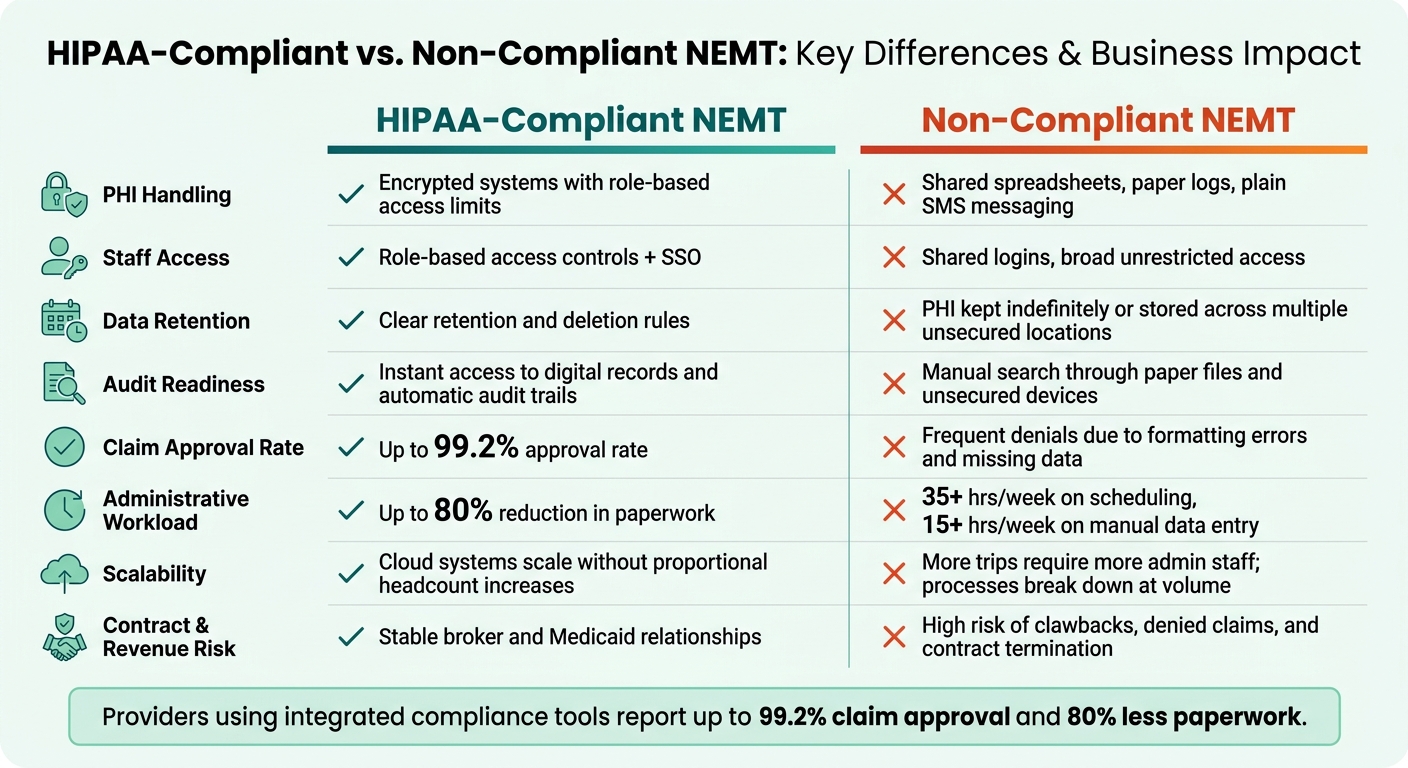
HIPAA-Compliant vs. Non-Compliant NEMT: Key Differences & Business Impact
The gap shows up in the small stuff. It’s there in how staff send manifests, who can open trip data, and how long records stay on file. Those day-to-day choices shape risk, staff training, and billing.
Compliant Workflows: Secure Scheduling, Dispatch, and Billing
Compliant providers build PHI protection into daily work. They use secure platforms for scheduling, dispatch, tracking, and billing. Role-based access, SSO, and retention rules help control who can view PHI and how long it remains in the system. That leads to fewer access mistakes, cleaner audits, and less PHI exposure.
When those controls aren’t in place, even a simple shortcut can turn into a compliance problem.
Non-Compliant Workflows: Common Shortcuts That Create Risk
Non-compliant operations tend to pick convenience over security. Common warning signs include shared logins used by multiple staff members, texting member details over standard SMS, and keeping trip manifests in shared spreadsheets without encryption. Holding PHI without clear access limits or retention rules adds more risk.
| Area | Compliant Practice | Exposure Point |
|---|---|---|
| Data Handling | Encrypted systems | Shared spreadsheets without encryption |
| Access Controls | Role-based access; SSO | Shared logins |
| Data Retention | Clear retention and deletion rules | Indefinite retention |
What Brokers, Medicaid, and Accreditation Bodies Expect
These controls matter because outside partners judge providers by what they can show on paper and in systems. They want proof, not verbal claims. The main question is simple: can the provider show that these controls are in place? Independent audits and security frameworks can help confirm access control and data-handling practices.
The Risks of HIPAA Non-Compliance for NEMT Providers
When an NEMT provider falls short on HIPAA, protected health information can slip through the cracks in scheduling, dispatch, and billing. And once that happens, the problem usually doesn’t stay small for long.
It can turn into a breach issue, trigger audits, and bring enforcement risk. On top of that, the damage often hits two places at once: your bottom line and your day-to-day operations.
Breach and Audit Risk
Weak controls can throw a wrench into scheduling, dispatch, and billing. They also increase errors and make audits harder to deal with.
In plain terms, that can mean:
- Slower operations
- More claims friction
- More time spent fixing avoidable mistakes
Trust with Riders, Facilities, and Referral Partners
Poor privacy practices can damage trust with riders, facilities, brokers, and referral partners. That kind of damage isn’t just about reputation. It often shows up in concrete ways, like fines, denied claims, and pressure on contracts.
For NEMT providers, trust is a big deal. If partners think patient data isn’t being handled with care, relationships can get shaky fast.
How Compliance Affects Financial and Operational Outcomes Over Time
Beyond fines and claim denials, HIPAA compliance shapes how well a fleet runs as it grows. Over time, it affects claim approval, audit speed, staffing pressure, and whether contracts stay in place.
Lower Risk and Smoother Audits on the Compliant Side
When records are organized and digital, audits and claims move much faster. Compliant providers keep automatic audit trails in place. That includes GPS logs, electronic signatures, and trip manifests recorded in real time and stored securely. So when a broker review or Medicaid audit comes up, the response usually takes far less work.
The reported numbers back that up. Providers using integrated compliance tools report claim approval rates as high as 99.2% and an 80% reduction in paperwork.
Higher Overhead and Instability on the Non-Compliant Side
Manual work comes with a cost that builds over time. Non-compliant providers often spend 35 hours a week on scheduling alone, plus another 15 hours on manual data entry. And when a billing error appears, staff have to hunt for records spread across paper logs, personal phones, and unsecured spreadsheets. That eats up hours without bringing in any revenue.
It also gets harder as the fleet grows. Add more vehicles or drivers to a manual setup, and you usually need more admin staff to keep up. By contrast, compliant cloud-based systems can take on that growth without matching it with the same jump in headcount.
At scale, the gap is easy to see.
| Outcome | Compliant (Automated) | Non-Compliant (Manual) |
|---|---|---|
| Audit Readiness | Instant access to encrypted digital records and automatic audit trails | Manual search through paper files and unsecured devices |
| Administrative Workload | Up to 66% reduction through automation | High; ongoing manual entry and error correction |
| Claim Accuracy | Up to 99.2% approval rate | Frequent denials due to formatting errors and missing data |
| Contract Retention | Stable; meets broker and Medicaid standards | High risk of clawbacks or contract termination |
| Scalability | Cloud infrastructure grows with the fleet | Manual processes break down under higher trip volume |
Conclusion: How NEMT Operators Can Stay on the Compliant Side
Those day-to-day workflow choices shape whether a fleet stays audit-ready or ends up paying avoidable costs. Providers that stay compliant are in a stronger spot to keep contracts and handle audits. Providers that fall short can face denied claims, clawbacks, contract termination, and damage to their reputation with healthcare facilities and brokers such as Modivcare and MTM.
Accreditation shows that a fleet follows recognized standards for privacy, safety, and quality. And for small fleets, closing that gap often comes down to a handful of disciplined controls.
Next Steps for a Small NEMT Fleet
For small fleets, the first move is to tighten the places where PHI enters dispatch, billing, and driver communication. Start by mapping where PHI lives: dispatch logs, driver manifests, and billing records. Then put these controls in place:
- Eliminate shared logins. Set up role-based access so drivers can see only their own trip details, while dispatchers can access only what their role calls for.
- Use encrypted mobile apps for manifests and trip updates. Stop relying on paper logs and unencrypted messaging.
- Require a signed BAA from every dispatch, billing, and GPS vendor before you sign any contract.
- Train staff. Drivers and dispatchers should know basic HIPAA privacy rules and how to handle patient data during daily work.
- Verify your current software can generate GPS timestamps, electronic signatures, and digital trip records automatically. Use software that captures GPS timestamps, electronic signatures, and trip records for audits without extra manual work. Could you produce documentation tomorrow?
These steps don’t call for a huge budget. They call for consistency and tools built for regulated environments from day one.
FAQs
Does HIPAA apply to every NEMT company?
Yes – HIPAA applies to NEMT companies that act as covered entities or business associates by handling protected health information.
NEMT providers deal with patient data all the time during scheduling, billing, and transport. That means they need to keep that information secure and limit who can see it.
NEMT dispatch software can help support compliance with encrypted storage, role-based access, and audit trails. But software alone doesn’t make a company compliant. HIPAA compliance is still a legal requirement for any provider processing medical records.
What counts as PHI in daily NEMT work?
PHI in day-to-day NEMT work includes any patient details that can identify someone and are used for transport, scheduling, or billing. That can mean names, phone numbers, appointment types, and insurance or Medicaid ID numbers.
Because NEMT routing platforms and other cloud-based NEMT software process this data, they need to keep it protected in secure systems that are ready for audits. NEMT Cloud Dispatching is one example of a tool built to support these workflows in a secure way.
What should a small fleet fix first?
Small fleets should first move away from manual, disconnected workflows and onto an all-in-one, HIPAA-compliant digital platform. When scheduling, dispatch, billing, and compliance tracking live in one place, teams make fewer data-entry mistakes and can keep records ready for audits.
That means less admin work, better claim accuracy, and stronger compliance support as the business grows.