NEMT fleet insurance costs more because insurers price more than driving risk. They also look at passenger help, wheelchair equipment, trip records, claims, and contract rules. If you want a plain answer, your rate usually moves based on 7 things: drivers, qualification files, vehicles, garaging area, claims, trip type, and coverage limits.
Here’s the short version:
- Driver age and driving record: tickets, crashes, license status, and telematics data can change pricing fast.
- MVR checks and driver files: missing licenses, certifications, or trip records can push rates higher.
- Vehicle age and equipment: older vans, wheelchair lifts, ramps, and stretcher setups often cost more to insure and repair.
- Garaging ZIP code and territory: city traffic, rural miles, and multi-state service can add risk.
- Claims history and loss runs: past injury claims, loading incidents, and weak records matter a lot at renewal.
- Passenger risk and trip mix: stretcher, bariatric, door-to-door, and bed-to-bed trips usually bring more exposure than ambulatory rides.
- Coverage limits and deductibles: higher limits and lower deductibles often mean higher premiums.
A few numbers show why this matters. The article notes that New York improperly claimed $84.3 million in federal Medicaid reimbursements tied to NEMT payments that did not meet documentation rules. It also cites Indiana data showing 10.4% of NEMT requests were canceled in advance and 10.1% were needed but not completed. Those numbers help explain why insurers look hard at records and trip handling.
What can you control? Mostly your hiring files, MVR review schedule, maintenance logs, trip documentation, training, and dispatch records. Using NEMT dispatch software features can help organize these files for underwriters. What you usually can’t control: your ZIP code, traffic, broker insurance minimums, and some parts of your service mix.
| Factor | What insurers focus on | What often pushes price up |
|---|---|---|
| Drivers | MVRs, crashes, behavior data | Violations, harsh driving, expired licenses |
| Driver files | Licenses, certs, logs, signatures | Missing or incomplete records |
| Vehicles | Age, mileage, lift/ramp gear | Older units, weak maintenance history |
| Territory | Garage ZIP, route miles, states served | Dense traffic, long rural miles, multi-state work |
| Claims | Loss runs, injury trends | Repeat claims, loading/unloading incidents |
| Trip profile | Ambulatory vs. wheelchair vs. stretcher | Higher-acuity trips, more hands-on service |
| Policy setup | Limits, deductibles, endorsements | Higher limits, lower deductibles, added coverages |
If I boil the full article down to one point, it’s this: insurers price the whole NEMT business, not just the vans. Clean records, trained drivers, matched vehicles, and fewer claim issues can help keep premiums from climbing as much over time.
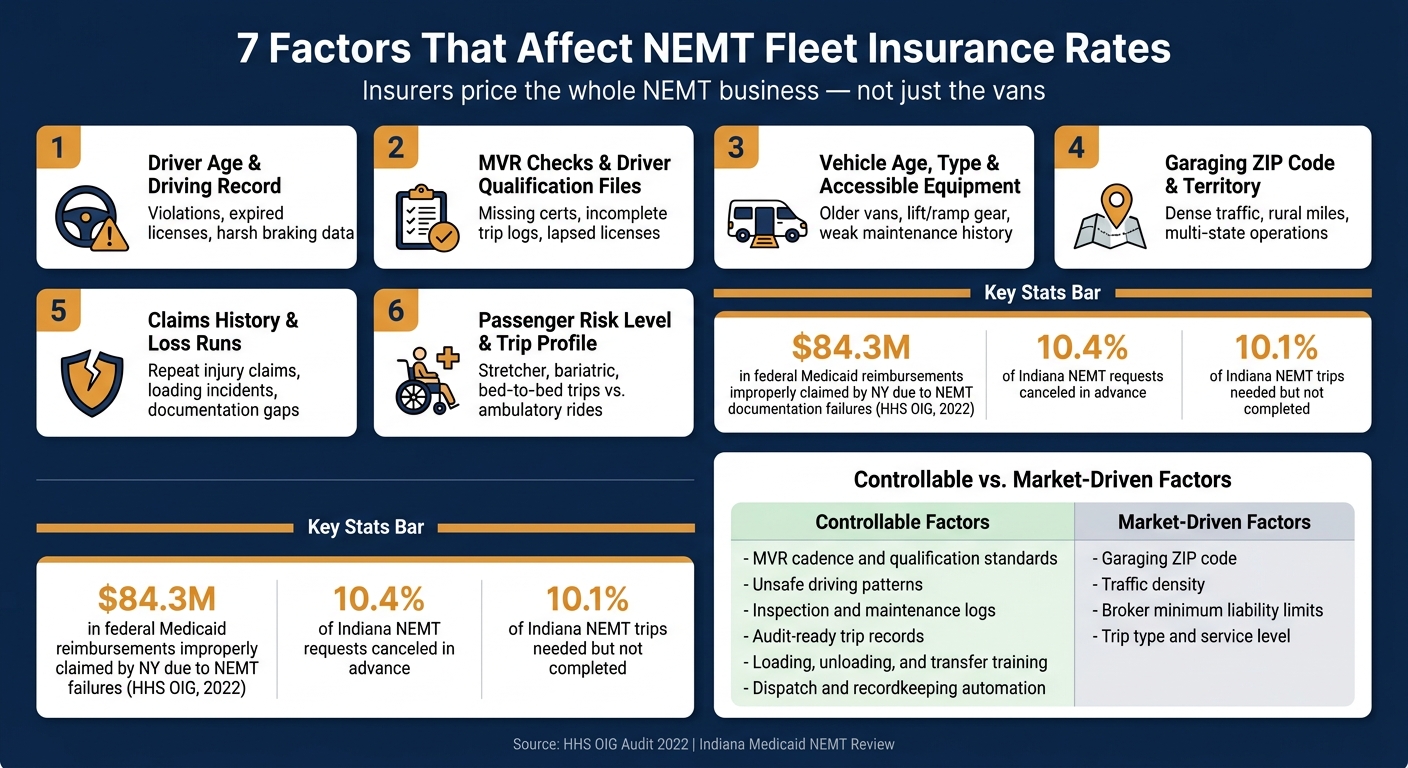
7 Factors That Affect NEMT Fleet Insurance Rates
How NEMT Fleet Insurance Pricing Differs from Standard Commercial Auto
Standard commercial auto pricing mostly comes down to driving risk and crash risk.
NEMT is different. It adds exposure tied to passenger assistance, mobility gear, and trip records that need to be complete and easy to review. Those added risks flow straight into the seven pricing inputs below.
Assisted Passenger Loading and Unloading
When drivers help passengers get in or out of the vehicle, the risk goes far beyond a normal auto claim. A slip, fall, or transfer injury can increase liability exposure in a big way. That close physical contact is also why SAM coverage is often added to the policy.
Wheelchair Vans and Lift Equipment
A wheelchair-accessible van usually costs more to fix than a standard van. Lifts, ramps, and securement systems need specialty parts and trained technicians, which pushes repair costs up. Insurers also look for written maintenance schedules for lifts, ramps, and securement systems.
Recurring Medical Routes and Documentation
Dialysis, chemotherapy, and other repeat trips run on tight schedules. If records are missing, that can lead to liability issues and audit problems. For insurers, documentation quality says a lot about how the business is run.
NEMT Cloud Dispatch can help operators store GPS timestamps and electronic signatures in one audit-ready trip record.
Contractual and Broker Insurance Requirements
Broker and Medicaid contracts often call for higher liability limits and extra endorsements. In plain English: the contract may set the floor for coverage, and that can push the premium higher.
That’s why the next seven factors carry so much weight at renewal and submission.
sbb-itb-af83355
1. Driver Age and Driving Record
What Underwriters Review
Underwriters usually begin with each driver’s MVR. They’re looking at license status, violations, and crash history. More insurers also use telematics coaching data to judge risk. Metrics like speeding, hard braking, and harsh acceleration give underwriters a clearer look at how drivers behave on the road day to day.
How Age and Record Affect Premium
Age does affect pricing, but violations and crash history often cause the bigger change in premium. The main red flags are expired licenses, speeding, harsh braking, and prior crashes. Those are the issues underwriters tend to focus on during review.
Operator Controls
Set up automated alerts for expiring licenses and recheck MVRs on a fixed schedule. Driver records matter a lot, but the next pricing layer for a fleet comes down to the vehicle itself.
2. MVR Checks and Driver Qualification Process
What Underwriters Review
Underwriters don’t just look at the MVR. They also review the full driver qualification file.
That file can include required credentials, inspection logs, e-signatures, and GPS-stamped trip records.
Higher-Risk Signals
Gaps in the file are a red flag. They suggest weak screening and poor recordkeeping.
Missing certifications, lapsed licenses, and incomplete trip documentation all point to higher claim risk, and underwriters price that into the policy.
Why It Changes Premium
When screening is inconsistent, it can signal weak hiring controls. And if hiring controls look loose, the odds of a claim go up. That’s one reason premiums climb.
Operator Controls
Digital files and automated expiration alerts make renewals easier to defend. They also cut down on the scramble that happens when a license or certification is close to expiring.
Centralized driver records help with day-to-day decisions too. They support skill-based assignment, so stretcher or bariatric trips can be matched to drivers with the right qualifications. That helps reduce liability and non-compliance risk. This includes maintaining HIPAA compliance in NEMT operations to protect sensitive patient data.
Once driver files are clean, underwriters shift to the vehicles themselves.
3. Vehicle Age, Type, and Accessible Equipment
After driver records, underwriters shift to the fleet itself. The age of each vehicle, its body style, mileage, and any installed accessible equipment all shape how they view risk.
What Underwriters Review
Underwriters look at vehicle type, age, mileage, maintenance history, and installed accessible equipment. They split ambulatory sedans, wheelchair-accessible vans, and stretcher units into separate groups because each one comes with different repair costs and liability exposure
For WAVs and stretcher units, they also check the lift or ramp type, securement ratings, and whether the equipment lines up with the documented mobility needs of the passengers being served. They also expect regular inspection and maintenance records
Higher-Risk Signals
The biggest red flag is simple: a vehicle assigned to the wrong rider. If a passenger’s mobility needs and the vehicle setup don’t match, that can point to both safety and liability issues.
Expired vehicle inspections and missing maintenance records send a similar message. To an underwriter, that can suggest the fleet is not being watched closely, which pushes risk higher
Why It Changes Premium
Specialized equipment can drive up repair bills and increase liability exposure. Older vehicles add more mechanical risk, and they often come with fewer safety features
Operator Controls
A few basic controls can help here:
- Use cloud-based or on-premise software for automated alerts for inspections, registration, and equipment certifications
- Require mobile pre-trip checks so lifts and ramps have a timestamped record before dispatch
Once the vehicle mix is clear, underwriters next look at where the fleet is garaged and operated.
4. Garaging ZIP Code and Operating Territory
After vehicle risk, underwriters look closely at where the fleet is garaged and how far it operates.
The garaging ZIP code has a direct effect on premium. Underwriters price both the primary garaging ZIP code and the operating territory. That can include urban, rural, and multi-state service areas.
What Underwriters Review and Higher-Risk Signals
Dense urban areas tend to bring more crash risk. Rural routes create a different problem: more miles on the road. Non-revenue miles on rural routes increase vehicle exposure and overall claim frequency. Unscheduled return trips in certain territories can also put pressure on dispatch, which may increase accident likelihood.
Multi-state operations get extra scrutiny. Why? They bring different Medicaid billing rules from one state to another, plus more audit risk. A 2022 HHS OIG audit found that New York improperly claimed $84.3 million in federal Medicaid reimbursements for NEMT payments that failed to meet documentation requirements.
Why It Changes Premium
More territory complexity means more chances for delays, longer routes, and documentation mistakes. That added friction pushes premium up.
Operator Controls
Operators can lower this risk with tighter routing discipline. A few steps matter most:
- Use territory-based routing rules to reduce empty miles and avoid unnecessary cross-coverage.
- Track broker scorecards, since they reward on-time performance and can affect renewal risk.
That geography-driven risk then shows up in the fleet’s claims record.
5. Claims History and Loss Runs
After vehicle and territory risk, underwriters turn to the fleet’s actual claims history. If you’re applying for NEMT fleet insurance or renewing a current policy, they’ll ask for loss runs. These reports sum up prior claims and show how the fleet has performed over time.
What Underwriters Review
Underwriters look for claim patterns and missing documentation. Injury claims and loading incidents carry more weight because NEMT has a higher liability risk in those situations. Gaps in documentation matter too. When records are missing, claims are harder to defend, and that can make them more costly.
Why It Changes Premium
A clean loss run is one of the clearest ways to bring down your premium. On the flip side, a history of the same incident types tells underwriters that similar losses may happen again. In Indiana’s Medicaid review, 10.4% of NEMT requests were canceled in advance, and 10.1% were needed but not completed.
Operator Controls
The best way to improve your claims profile before renewal is to reduce operating costs by fixing documentation gaps now. If something isn’t being recorded, tighten it up before it turns into a pricing issue. Telematics can also help spot speeding and harsh braking early, so you can correct those habits before they appear in the loss run. And when the loss run stays clean, the next renewal is usually easier to price.
6. Passenger Risk Level and Trip Profile
After driver, vehicle, and territory risk, underwriters turn to the passengers and the trips themselves.
For NEMT, pricing often comes down to three things: trip mix, passenger acuity, and service level. A stretcher run is not priced like an ambulatory curb-to-curb trip. The same goes for bariatric and door-to-door service, where staff do more hands-on work and the chance of a handling-related claim goes up.
What Underwriters Review
The first thing underwriters usually check is your trip mix. They want to see what share of trips are ambulatory, wheelchair, or stretcher.
They also review service level – curb-to-curb, door-to-door, or bed-to-bed. Each step adds more staff involvement. And with that, more exposure.
Why It Changes Premium
Higher-acuity passengers shift more of the risk away from auto liability and toward general liability. That makes sense when you think about where claims can happen: not just on the road, but during loading, unloading, transfers, and hands-on assistance.
Multiple-passenger trips can add even more passenger-handling exposure. Over time, that can increase the odds of a claim. So trip mix is a direct pricing input, not just an ops detail.
Higher-Risk Signals
A high share of stretcher or bariatric transports without documented training for those runs is a red flag.
Another problem is weak recordkeeping. If you can’t show what level of help was given – and who gave it – claims get harder to defend. And when claims are harder to defend, premiums get tougher to control.
Operator Controls
Clear trip records can make a big difference. GPS timestamps and electronic signatures help show that the right assistance was provided on each trip.
It also helps to use software that matches the right vehicle to the rider’s needs. On top of that, automated alerts for expiring driver licenses and medical training certifications can help make sure only qualified staff are assigned to high-acuity runs.
NEMT Cloud Dispatch can support scheduling, dispatch, fleet management, and GPS tracking for higher-risk trips. The next pricing lever is how much coverage the policy carries.
7. Coverage Selections and Policy Limits
Coverage limits and deductibles have a direct effect on premium.
What Underwriters Review
Underwriters look at the full policy setup: auto liability limits, general liability, physical damage, and special endorsements such as Sexual Abuse or Molestation (SAM) coverage. General liability also matters because it applies to non-auto injury claims, including loading and unloading incidents.
Why It Changes Premium
The math here is pretty simple. Higher limits mean the insurer may have to pay more on a claim, so premium goes up. Lower deductibles also tend to push premium higher because the carrier takes on more of the first-dollar loss.
On the flip side, higher deductibles usually bring premium down if the fleet can handle the out-of-pocket hit. That makes limits and deductibles one of the few parts of pricing an operator can adjust in a direct way.
Major brokers like ModivCare and MTM often require minimum liability limits – commonly $1 million or more – as a contract condition. In practice, that sets a floor under premium. After those required limits are in place, the main cost tradeoff becomes simple: how much risk the fleet keeps and how much it passes to the insurer.
Operator Controls
This is where operators have some room to act. The big job is matching endorsements to the service being provided. A fleet that handles stretcher or bariatric trips needs coverage that fits those trip types.
The main decisions that affect premium are:
- choosing limits above the broker minimum
- setting deductibles based on the fleet’s cash reserves
- making sure endorsements match the trips being dispatched
Coverage choices are the part of pricing an operator can control most directly. The next section separates those choices from the parts driven by the market.
Controllable vs. Market-Driven Pricing Factors at a Glance
The seven factors above fall into two simple groups: what operators can change and what the market mostly sets. And those inputs don’t affect premiums in the same way. Some come from day-to-day fleet management. Others are tied to location, traffic, and contract terms.
Use the table below for a quick side-by-side view of controllable and fixed pricing inputs.
| Controllable Factors | Market-Driven Factors |
|---|---|
| MVR cadence and qualification standards | Garaging ZIP code |
| Unsafe driving patterns | Traffic density |
| Inspection and maintenance logs | Broker requirements: minimum liability limits |
| Audit-ready trip records | Trip type and service level |
| Loading, unloading, and transfer training | |
| Dispatch and recordkeeping automation |
That’s why two NEMT fleets that look similar on the surface can still get very different quotes.
Conclusion
These seven inputs explain why NEMT quotes go up or down. NEMT fleet insurance pricing follows underwriting risk. In plain English, underwriters look at the entire operating model, not just the vehicle. If one area looks weak, the premium can climb.
The big difference comes down to what the market decides versus what operators can control. Some costs are built into the business. But compliance and documentation still shape the final quote. Clean hiring files, maintenance logs, and trip records often help support better renewal pricing. Operators that treat compliance and safety like daily habits tend to get more stable pricing over time. In NEMT, disciplined operations are the fastest path to steadier premiums.
FAQs
Why is NEMT insurance higher than standard commercial auto?
NEMT insurance premiums run higher because these providers face more risk than a standard commercial auto business.
They’re transporting vulnerable passengers, often people with mobility limits, and that changes the risk picture fast. Vehicles may include lifts, ramps, wheelchairs, and other special equipment. Drivers and staff also have to handle passengers with more care during pickup, drop-off, and transport.
Insurers look at more than just the vehicles, too. They weigh how often trips happen, the medical nature of the service, and the possible financial hit from denied claims. They also pay close attention to how well a fleet documents each trip and whether the company can show strong risk-control practices.
Which pricing factors can I actually control?
Focus on the things that show underwriters you take risk seriously. You may be able to lower premiums by keeping drivers’ MVRs clean, staying on top of vehicle maintenance to help assets last longer, and putting solid safety protocols in place to cut down on accidents and claims.
It also helps to review your coverage limits and deductibles on a regular basis. And if you use NEMT routing platforms like RouteGenie to reduce deadhead miles, that may help support a lower-risk profile.
How can I lower my NEMT fleet insurance rates?
Lower rates by showing insurers strong risk management and tight operational control. Premiums often go up when fleets can’t clearly show that they handle risk well.
NEMT dispatch software helps by giving teams better visibility, cutting manual mistakes, and keeping trip records accurate. GPS-verified timestamps, electronic signatures, and complete trip data give insurers the audit trail they want.